


Page 57 - Read Online
P. 57
Yue et al. Soft Sci 2023;3:13  https://dx.doi.org/10.20517/ss.2023.02             Page 5 of 11


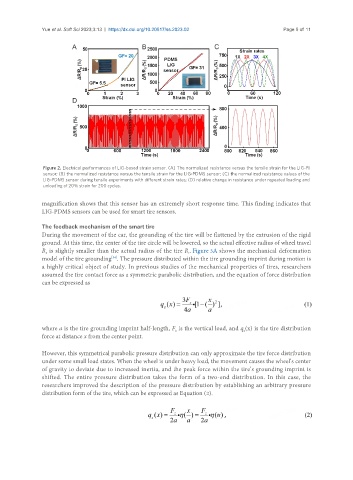
                Figure 2. Electrical performances of LIG-based strain sensor. (A) The normalized resistance versus the tensile strain for the LIG-PI
                sensor; (B) the normalized resistance versus the tensile strain for the LIG-PDMS sensor; (C) the normalized resistance values of the
                LIG-PDMS sensor during tensile experiments with different strain rates; (D) relative change in resistance under repeated loading and
                unloading of 20% strain for 200 cycles.

               magnification shows that this sensor has an extremely short response time. This finding indicates that
               LIG-PDMS sensors can be used for smart tire sensors.

               The feedback mechanism of the smart tire
               During the movement of the car, the grounding of the tire will be flattened by the extrusion of the rigid
               ground. At this time, the center of the tire circle will be lowered, so the actual effective radius of wheel travel
               R  is slightly smaller than the actual radius of the tire R . Figure 3A shows the mechanical deformation
                                                                 r
                e
               model of the tire grounding . The pressure distributed within the tire grounding imprint during motion is
                                       [54]
               a highly critical object of study. In previous studies of the mechanical properties of tires, researchers
               assumed the tire contact force as a symmetric parabolic distribution, and the equation of force distribution
               can be expressed as


               where a is the tire grounding imprint half-length, F  is the vertical load, and q (x) is the tire distribution
                                                            z
                                                                                   z
               force at distance x from the center point.

               However, this symmetrical parabolic pressure distribution can only approximate the tire force distribution
               under some small load states. When the wheel is under heavy load, the movement causes the wheel’s center
               of gravity to deviate due to increased inertia, and the peak force within the tire’s grounding imprint is
               shifted. The entire pressure distribution takes the form of a two-end distribution. In this case, the
               researchers improved the description of the pressure distribution by establishing an arbitrary pressure
               distribution form of the tire, which can be expressed as Equation (2).

