


Page 19 - Read Online
P. 19
Page 16 of 26                            Xiao et al. Soft Sci 2023;3:11  https://dx.doi.org/10.20517/ss.2023.03


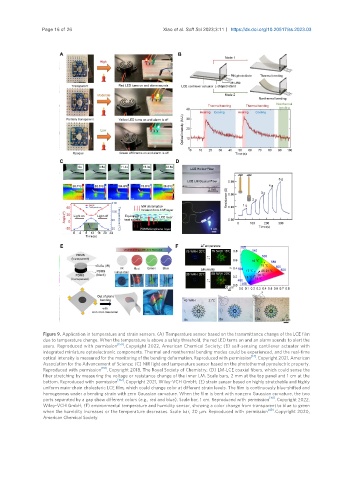
                Figure 9. Application in temperature and strain sensors. (A) Temperature sensor based on the transmittance change of the LCE film
                due to temperature change. When the temperature is above a safety threshold, the red LED turns on and an alarm sounds to alert the
                users. Reproduced with  permission [150] . Copyright 2022, American Chemical Society; (B) self-sensing cantilever actuator with
                integrated miniature optoelectronic components. Thermal and nonthermal bending modes could be experienced, and the real-time
                optical intensity is measured for the monitoring of the bending deformation. Reproduced with permission [14] . Copyright 2021, American
                Association for the Advancement of Science; (C) NIR light and temperature sensor based on the photothermal pyroelectric property.
                Reproduced with  permission [151] . Copyright 2018, The Royal Society of Chemistry; (D) LM-LCE coaxial fibers, which could sense the
                fiber stretching by measuring the voltage or resistance change of the inner LM. Scale bars, 2 mm at the top panel and 1 cm at the
                bottom. Reproduced with permission [152] . Copyright 2021, Wiley-VCH GmbH; (E) strain sensor based on highly stretchable and highly
                uniform main-chain cholesteric LCE film, which could change color at different strain levels. The film is continuously blue-shifted and
                homogenous under a bending strain with zero Gaussian curvature. When the film is bent with nonzero Gaussian curvature, the two
                parts separated by a gap show different colors (e.g., red and blue). Scale bar, 1 cm. Reproduced with  permission [48] . Copyright 2022,
                Wiley-VCH GmbH; (F) environmental temperature and humidity sensor, showing a color change from transparent to blue to green
                when the humidity increases or the temperature decreases. Scale bar, 20 μm. Reproduced with  permission [49] . Copyright 2020,
                American Chemical Society.

