


Page 14 - Read Online
P. 14
Xiao et al. Soft Sci 2023;3:11  https://dx.doi.org/10.20517/ss.2023.03          Page 11 of 26


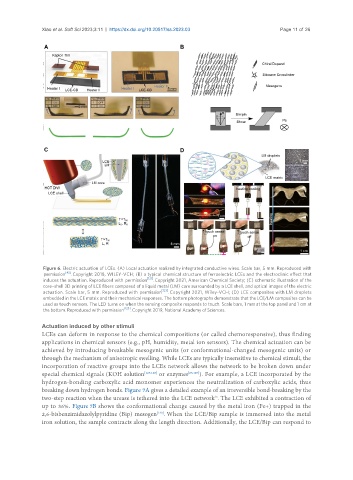
                Figure 6. Electric actuation of LCEs. (A) Local actuation realized by integrated conductive wires. Scale bar, 5 mm. Reproduced with
                permission [42] . Copyright 2018, WILEY-VCH; (B) a typical chemical structure of ferroelectric LCEs and the electroclinic effect that
                induces the actuation. Reproduced with  permission [121] . Copyright 2021, American Chemical Society; (C) schematic illustration of the
                core–shell 3D printing of LCE fibers composed of a liquid metal (LM) core surrounded by a LCE shell, and optical images of the electric
                                                       [123]
                actuation. Scale bar, 5 mm. Reproduced with  permission  . Copyright 2021, Wiley-VCH; (D) LCE composites with LM droplets
                embedded in the LCE matrix and their mechanical responses. The bottom photographs demonstrate that the LCE/LM composites can be
                used as touch sensors. The LED turns on when the sensing composite responds to touch. Scale bars, 1 mm at the top panel and 1 cm at
                                           [125]
                the bottom. Reproduced with permission  . Copyright 2019, National Academy of Sciences.
               Actuation induced by other stimuli
               LCEs can deform in response to the chemical compositions (or called chemoresponsive), thus finding
               applications in chemical sensors (e.g., pH, humidity, metal ion sensors). The chemical actuation can be
               achieved by introducing breakable mesogenic units (or conformational-changed mesogenic units) or
               through the mechanism of anisotropic swelling. While LCEs are typically insensitive to chemical stimuli, the
               incorporation of reactive groups into the LCEs network allows the network to be broken down under
               special chemical signals (KOH solution [127,128]  or enzymes [25,129] ). For example, a LCE incorporated by the
               hydrogen-bonding carboxylic acid monomer experiences the neutralization of carboxylic acids, thus
               breaking down hydrogen bonds. Figure 7A gives a detailed example of an irreversible bond-breaking by the
               two-step reaction when the urease is tethered into the LCE network . The LCE exhibited a contraction of
                                                                         25
               up to 36%. Figure 7B shows the conformational change caused by the metal iron (Fe+) trapped in the
               2,6-bisbenzimidazolylpyridine (Bip) mesogen . When the LCE/Bip sample is immersed into the metal
                                                      [130]
               iron solution, the sample contracts along the length direction. Additionally, the LCE/Bip can respond to

