


Page 11 - Read Online
P. 11
Page 8 of 26                             Xiao et al. Soft Sci 2023;3:11  https://dx.doi.org/10.20517/ss.2023.03


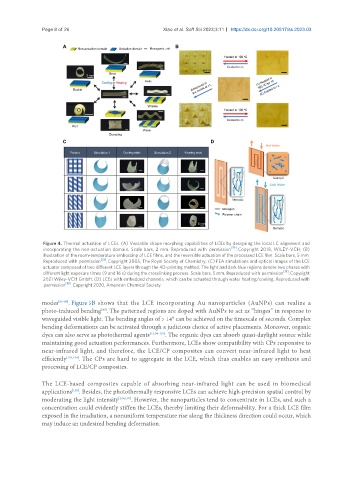
                Figure 4. Thermal actuation of LCEs. (A) Versatile shape morphing capabilities of LCEs by designing the local LC alignment and
                                                                               [79]
                incorporating the non-actuation domain. Scale bars, 2 mm. Reproduced with  permission  . Copyright 2018, WILEY-VCH; (B)
                illustration of the room-temperature embossing of LCE films, and the reversible actuation of the processed LCE film. Scale bars, 5 mm.
                                   [23]
                Reproduced with permission  . Copyright 2005, The Royal Society of Chemistry; (C) FEA simulations and optical images of the LCE
                actuator composed of two different LCE layers through the 4D-printing method. The light and dark blue regions denote two phases with
                                                                                                 [19]
                different light exposure times (9 and 16 s) during the crosslinking process. Scale bars, 5 mm. Reproduced with permission  . Copyright
                2021 Wiley-VCH GmbH; (D) LCEs with embedded channels, which can be actuated through water heating/cooling. Reproduced with
                       [88]
                permission  . Copyright 2020, American Chemical Society.
               modes [95-98] . Figure 5B  shows  that  the  LCE  incorporating  Au  nanoparticles  (AuNPs)  can  realize  a
               photo-induced bending . The patterned regions are doped with AuNPs to act as “hinges” in response to
                                   [40]
               waveguided visible light. The bending angles of > 14° can be achieved on the timescale of seconds. Complex
               bending deformations can be activated through a judicious choice of active placements. Moreover, organic
               dyes can also serve as photothermal agents [13,99-102] . The organic dyes can absorb quasi-daylight source while
               maintaining good actuation performances. Furthermore, LCEs show compatibility with CPs responsive to
               near-infrared light, and therefore, the LCE/CP composites can convert near-infrared light to heat
               efficiently [103,104] . The CPs are hard to aggregate in the LCE, which thus enables an easy synthesis and
               processing of LCE/CP composites.


               The LCE-based composites capable of absorbing near-infrared light can be used in biomedical
                         [105]
               applications . Besides, the photothermally responsive LCEs can achieve high-precision spatial control by
               moderating the light intensity [106,107] . However, the nanoparticles tend to concentrate in LCEs, and such a
               concentration could evidently stiffen the LCEs, thereby limiting their deformability. For a thick LCE film
               exposed in the irradiation, a nonuniform temperature rise along the thickness direction could occur, which
               may induce an undesired bending deformation.

