


Page 6 - Read Online
P. 6
Xiao et al. Soft Sci 2023;3:11  https://dx.doi.org/10.20517/ss.2023.03           Page 3 of 26


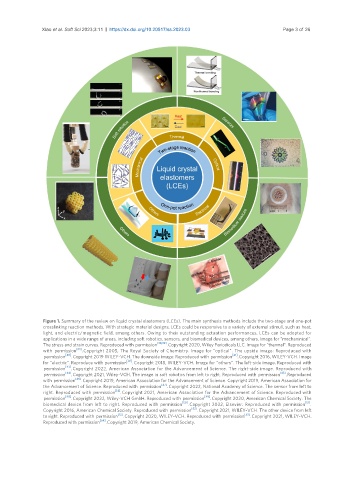
                Figure 1. Summary of the review on liquid crystal elastomers (LCEs). The main synthesis methods include the two-stage and one-pot
                crosslinking reaction methods. With strategic material designs, LCEs could be responsive to a variety of external stimuli, such as heat,
                light, and electric/magnetic field, among others. Owing to their outstanding actuation performances, LCEs can be adopted for
                applications in a wide range of areas, including soft robotics, sensors, and biomedical devices, among others. Image for “mechaninical”.
                The stress and strain curves. Reproduced with permission [38,39] . Copyright 2020, Wiley Periodicals LLC. Image for “thermal”. Reproduced
                with  permission [23] . Copyright 2005, The Royal Society of Chemistry. Image for “optical”. The upside image: Reproduced with
                permission [40] . Copyright 2019 WILEY-VCH. The downside image: Reproduced with permission [41] . Copyright 2016, WILEY-VCH. Image
                for “electric”. Reproduce with  permission [42] . Copyright 2018, WILEY-VCH. Image for “others”. The left-side image. Reproduced with
                permission [43] . Copyright 2022, American Association for the Advancement of Science. The right-side image. Reproduced with
                permission [44] . Copyright 2021, Wiley-VCH. The image in soft robotics from left to right. Reproduced with  permission [45] . Reproduced
                with permission [46] . Copyright 2019, American Association for the Advancement of Science. Copyright 2019, American Association for
                the Advancement of Science. Reproduced with  permission [47] . Copyright 2022, National Academy of Science. The sensor from left to
                right. Reproduced with  permission [14] . Copyright 2021, American Association for the Advancement of Science. Reproduced with
                permission [48] . Copyright 2022, Wiley-VCH GmbH. Reproduced with permission [49] . Copyright 2020, American Chemical Society. The
                biomedical device from left to right. Reproduced with  permission [50] . Copyright 2022, Elsevier. Reproduced with  permission [51] .
                Copyright 2016, American Chemical Society. Reproduced with permission [52] . Copyright 2021, WILEY-VCH. The other device from left
                to right. Reproduced with  permission [12] . Copyright 2020, WILEY-VCH. Reproduced with  permission [53] . Copyright 2021, WILEY-VCH.
                Reproduced with permission [54] . Copyright 2019, American Chemical Society.

