


Page 9 - Read Online
P. 9
Page 6 of 26                             Xiao et al. Soft Sci 2023;3:11  https://dx.doi.org/10.20517/ss.2023.03


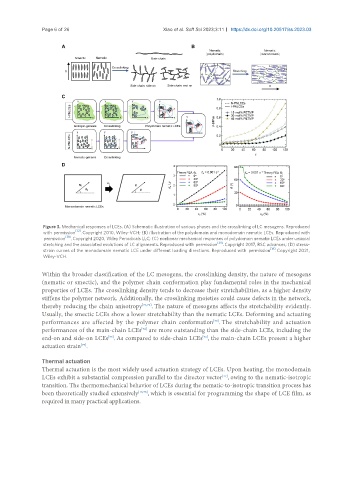
                Figure 3. Mechanical responses of LCEs. (A) Schematic illustration of various phases and the crosslinking of LC mesogens. Reproduced
                with permission [32] . Copyright 2010, Wiley-VCH; (B) illustration of the polydomain and monodomain nematic LCEs. Reproduced with
                permission [38] . Copyright 2020, Wiley Periodicals LLC; (C) nonlinear mechanical responses of polydomain nematic LCEs under uniaxial
                stretching and the associated evolutions of LC alignments. Reproduced with permission [39] . Copyright 2017, RSC advances; (D) stress-
                strain curves of the monodomain nematic LCE under different loading directions. Reproduced with  permission [16] . Copyright 2021,
                Wiley-VCH.

               Within the broader classification of the LC mesogens, the crosslinking density, the nature of mesogens
               (nematic or smectic), and the polymer chain conformation play fundamental roles in the mechanical
               properties of LCEs. The crosslinking density tends to decrease their stretchabilities, as a higher density
               stiffens the polymer network. Additionally, the crosslinking moieties could cause defects in the network,
               thereby reducing the chain anisotropy [71,72] . The nature of mesogens affects the stretchability evidently.
               Usually, the smectic LCEs show a lower stretchability than the nematic LCEs. Deforming and actuating
               performances are affected by the polymer chain conformation . The stretchability and actuation
                                                                         [73]
               performances of the main-chain LCEs  are more outstanding than the side-chain LCEs, including the
                                                 [74]
               end-on and side-on LCEs . As compared to side-chain LCEs , the main-chain LCEs present a higher
                                     [75]
                                                                     [76]
               actuation strain .
                            [77]
               Thermal actuation
               Thermal actuation is the most widely used actuation strategy of LCEs. Upon heating, the monodomain
               LCEs exhibit a substantial compression parallel to the director vector , owing to the nematic-isotropic
                                                                            [17]
               transition. The thermomechanical behavior of LCEs during the nematic-to-isotropic transition process has
               been theoretically studied extensively [16,78] , which is essential for programming the shape of LCE film, as
               required in many practical applications.

