


Page 16 - Read Online
P. 16
Xiao et al. Soft Sci 2023;3:11  https://dx.doi.org/10.20517/ss.2023.03          Page 13 of 26

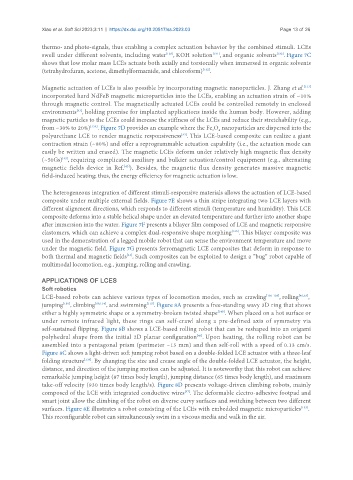
               thermo- and photo-signals, thus enabling a complex actuation behavior by the combined stimuli. LCEs
                                                                         [131]
                                                                                              [132]
               swell under different solvents, including water , KOH solution , and organic solvents . Figure 7C
                                                         [128]
               shows that low molar mass LCEs actuate both axially and torsionally when immersed in organic solvents
               (tetrahydrofuran, acetone, dimethylformamide, and chloroform) .
                                                                     [132]
               Magnetic actuation of LCEs is also possible by incorporating magnetic nanoparticles. J. Zhang et al.
                                                                                                       [133]
               incorporated hard NdFeB magnetic microparticles into the LCEs, enabling an actuation strain of ~10%
               through magnetic control. The magnetically actuated LCEs could be controlled remotely in enclosed
               environments , holding promise for implanted applications inside the human body. However, adding
                           [43]
               magnetic particles to the LCEs could increase the stiffness of the LCEs and reduce their stretchability (e.g.,
                               [134]
               from ~30% to 20%) . Figure 7D provides an example where the Fe O  nanoparticles are dispersed into the
                                                                           4
                                                                         3
               polyurethane LCE to render magnetic responsiveness . This LCE-based composite can realize a giant
                                                              [43]
               contraction strain (~80%) and offer a reprogrammable actuation capability (i.e., the actuation mode can
               easily be written and erased). The magnetic LCEs deform under relatively high magnetic flux density
               (~50Gs) , requiring complicated auxiliary and bulkier actuation/control equipment (e.g., alternating
                      [43]
               magnetic fields device in Ref. ). Besides, the magnetic flux density generates massive magnetic
                                           [43]
               field-induced heating; thus, the energy efficiency for magnetic actuation is low.
               The heterogeneous integration of different stimuli-responsive materials allows the actuation of LCE-based
               composite under multiple external fields. Figure 7E shows a thin stripe integrating two LCE layers with
               different alignment directions, which responds to different stimuli (temperature and humidity). This LCE
               composite deforms into a stable helical shape under an elevated temperature and further into another shape
               after immersion into the water. Figure 7F presents a bilayer film composed of LCE and magnetic responsive
               elastomers, which can achieve a complex dual-responsive shape morphing . This bilayer composite was
                                                                               [135]
               used in the demonstration of a legged mobile robot that can sense the environment temperature and move
               under the magnetic field. Figure 7G presents ferromagnetic LCE composites that deform in response to
               both thermal and magnetic fields . Such composites can be exploited to design a “bug” robot capable of
                                            [44]
               multimodal locomotion, e.g., jumping, rolling and crawling.

               APPLICATIONS OF LCES
               Soft robotics
               LCE-based robots can achieve various types of locomotion modes, such as crawling [136-138] , rolling [46,63] ,
                      [139]
               jumping , climbing [89,114] , and swimming . Figure 8A presents a free-standing wavy 3D ring that shows
                                                  [113]
               either a highly symmetric shape or a symmetry-broken twisted shape . When placed on a hot surface or
                                                                          [140]
               under remote infrared light, these rings can self-crawl along a pre-defined axis of symmetry via
               self-sustained flipping. Figure 8B shows a LCE-based rolling robot that can be reshaped into an origami
               polyhedral shape from the initial 2D planar configuration . Upon heating, the rolling robot can be
                                                                   [46]
               assembled into a pentagonal prism (perimeter ~15 mm) and then self-roll with a speed of 0.13 cm/s.
               Figure 8C shows a light-driven soft jumping robot based on a double-folded LCE actuator with a three-leaf
                             [139]
               folding structure . By changing the size and crease angle of the double-folded LCE actuator, the height,
               distance, and direction of the jumping motion can be adjusted. It is noteworthy that this robot can achieve
               remarkable jumping height (87 times body length), jumping distance (65 times body length), and maximum
               take-off velocity (930 times body length/s). Figure 8D presents voltage-driven climbing robots, mainly
               composed of the LCE with integrated conductive wires . The deformable electro-adhesive footpad and
                                                               [47]
               smart joint allow the climbing of the robot on diverse curvy surfaces and switching between two different
               surfaces. Figure 8E illustrates a robot consisting of the LCEs with embedded magnetic microparticles .
                                                                                                      [133]
               This reconfigurable robot can simultaneously swim in a viscous media and walk in the air.

