


Page 21 - Read Online
P. 21
Page 18 of 26                            Xiao et al. Soft Sci 2023;3:11  https://dx.doi.org/10.20517/ss.2023.03


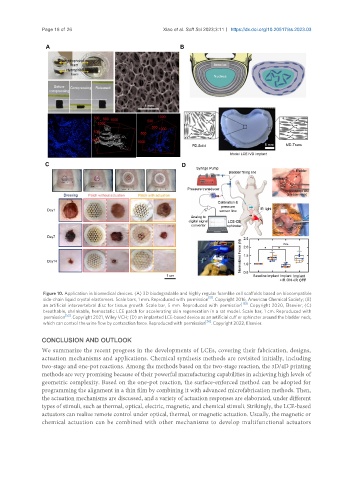
                Figure 10. Application in biomedical devices. (A) 3D biodegradable and highly regular foamlike cell scaffolds based on biocompatible
                                                                       [51]
                side-chain liquid crystal elastomers. Scale bars, 1 mm. Reproduced with permission  . Copyright 2016, American Chemical Society; (B)
                                                                                  [153]
                an artificial intervertebral disc for tissue growth. Scale bar, 5 mm. Reproduced with  permission  . Copyright 2020, Elsevier; (C)
                breathable, shrinkable, hemostatic LCE patch for accelerating skin regeneration in a rat model. Scale bar, 1 cm. Reproduced with
                permission [52] . Copyright 2021, Wiley VCH; (D) an implanted LCE-based device as an artificial cuff or sphincter around the bladder neck,
                which can control the urine flow by contraction force. Reproduced with permission [50] . Copyright 2022, Elsevier.

               CONCLUSION AND OUTLOOK
               We summarize the recent progress in the developments of LCEs, covering their fabrication, designs,
               actuation mechanisms and applications. Chemical synthesis methods are revisited initially, including
               two-stage and one-pot reactions. Among the methods based on the two-stage reaction, the 3D/4D printing
               methods are very promising because of their powerful manufacturing capabilities in achieving high levels of
               geometric complexity. Based on the one-pot reaction, the surface-enforced method can be adopted for
               programming the alignment in a thin film by combining it with advanced microfabrication methods. Then,
               the actuation mechanisms are discussed, and a variety of actuation responses are elaborated, under different
               types of stimuli, such as thermal, optical, electric, magnetic, and chemical stimuli. Strikingly, the LCE-based
               actuators can realize remote control under optical, thermal, or magnetic actuation. Usually, the magnetic or
               chemical actuation can be combined with other mechanisms to develop multifunctional actuators

