


Page 22 - Read Online
P. 22
Xiao et al. Soft Sci 2023;3:11  https://dx.doi.org/10.20517/ss.2023.03          Page 19 of 26


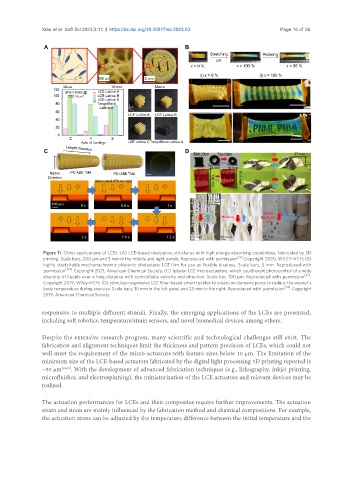
                Figure 11. Other applications of LCEs. (A) LCE-based dissipative structures with high energy-absorbing capabilities, fabricated by 3D
                printing. Scale bars, 200 μm and 5 mm in the middle and right panels. Reproduced with permission [12] . Copyright 2020, WILEY-VCH; (B)
                highly stretchable mechanochromic photonic cholesteric LCE film for use as flexible displays. Scale bars, 5 mm. Reproduced with
                       [154]
                permission  . Copyright 2021, American Chemical Society; (C) tubular LCE microactuators, which could exert photocontrol of a wide
                                                                                                        [53]
                diversity of liquids over a long distance with controllable velocity and direction. Scale bar, 100 μm. Reproduced with  permission  .
                Copyright 2019, Wiley-VCH; (D) stimulus-responsive LCE fiber-based smart textiles to create on-demand pores to reduce the wearer’s
                body temperature during exercise. Scale bars, 10 mm in the left panel and 25 mm in the right. Reproduced with permission [54] . Copyright
                2019, American Chemical Society.

               responsive to multiple different stimuli. Finally, the emerging applications of the LCEs are presented,
               including soft robotics, temperature/strain sensors, and novel biomedical devices, among others.

               Despite the extensive research progress, many scientific and technological challenges still exist. The
               fabrication and alignment techniques limit the thickness and pattern precision of LCEs, which could not
               well meet the requirement of the micro-actuators with feature sizes below 10 µm. The limitation of the
               minimum size of the LCE-based actuators fabricated by the digital light processing 3D printing reported is
               ~50 µm [14,30] . With the development of advanced fabrication techniques (e.g., lithography, inkjet printing,
               microfluidics, and electrospinning), the miniaturization of the LCE actuators and relevant devices may be
               realized.


               The actuation performances for LCEs and their composites require further improvements. The actuation
               strain and stress are mainly influenced by the fabrication method and chemical compositions. For example,
               the actuation stress can be adjusted by the temperature difference between the initial temperature and the

