


Page 108 - Read Online
P. 108
Page 20 of 30                            Kim et al. Soft Sci 2023;3:16  https://dx.doi.org/10.20517/ss.2023.07


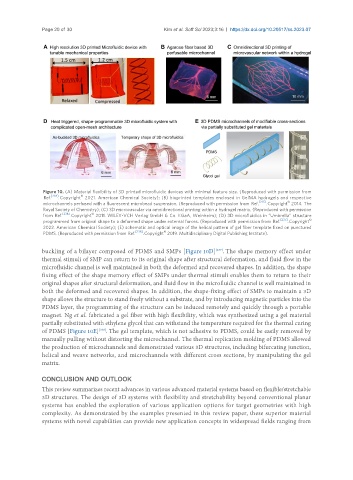
                Figure 10. (A) Material flexibility of 3D printed microfluidic devices with minimal feature size. (Reproduced with permission from
                  [234]     ©
                Ref.  . Copyright  2021. American Chemical Society); (B) bioprinted templates enclosed in GelMA hydrogels and respective
                                                                                        [235]     ©
                microchannels perfused with a fluorescent microbead suspension. (Reproduced with permission from  Ref.  . Copyright  2014. The
                Royal Society of Chemistry); (C) 3D microvascular via omnidirectional printing within a hydrogel matrix. (Reproduced with permission
                      [236]     ©
                from  Ref.  . Copyright  2011. WILEY-VCH Verlag GmbH & Co. KGaA, Weinheim); (D) 3D microfluidics in “Umbrella” structure
                                                                                                [237]    ©
                programmed from original shape to a deformed shape under external forces. (Reproduced with permission from  Ref.  . Copyright
                2022. American Chemical Society); (E) schematic and optical image of the helical pattern of gel fiber template fixed on punctured
                                               [238]    ©
                PDMS. (Reproduced with permission from Ref.  . Copyright  2019. Multidisciplinary Digital Publishing Institute).
               buckling of a bilayer composed of PDMS and SMPs [Figure 10D] . The shape memory effect under
                                                                          [237]
               thermal stimuli of SMP can return to its original shape after structural deformation, and fluid flow in the
               microfluidic channel is well maintained in both the deformed and recovered shapes. In addition, the shape
               fixing effect of the shape memory effect of SMPs under thermal stimuli enables them to return to their
               original shapes after structural deformation, and fluid flow in the microfluidic channel is well maintained in
               both the deformed and recovered shapes. In addition, the shape-fixing effect of SMPs to maintain a 3D
               shape allows the structure to stand freely without a substrate, and by introducing magnetic particles into the
               PDMS layer, the programming of the structure can be induced remotely and quickly through a portable
               magnet. Ng et al. fabricated a gel fiber with high flexibility, which was synthesized using a gel material
               partially substituted with ethylene glycol that can withstand the temperature required for the thermal curing
               of PDMS [Figure 10E] . The gel template, which is not adhesive to PDMS, could be easily removed by
                                  [238]
               manually pulling without distorting the microchannel. The thermal replication molding of PDMS allowed
               the production of microchannels and demonstrated various 3D structures, including bifurcating junction,
               helical and weave networks, and microchannels with different cross sections, by manipulating the gel
               matrix.

               CONCLUSION AND OUTLOOK
               This review summarizes recent advances in various advanced material systems based on flexible/stretchable
               3D structures. The design of 3D systems with flexibility and stretchability beyond conventional planar
               systems has enabled the exploration of various application options for target geometries with high
               complexity. As demonstrated by the examples presented in this review paper, these superior material
               systems with novel capabilities can provide new application concepts in widespread fields ranging from

