


Page 105 - Read Online
P. 105
Kim et al. Soft Sci 2023;3:16  https://dx.doi.org/10.20517/ss.2023.07           Page 17 of 30


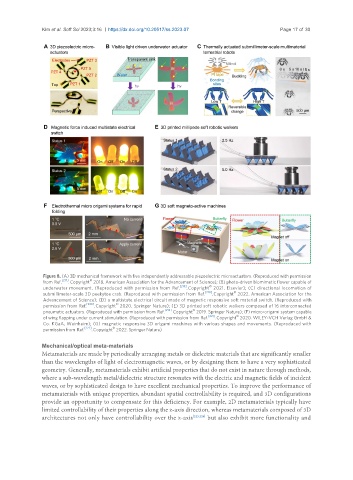
                Figure 8. (A) 3D mechanical framework with five independently addressable piezoelectric microactuators. (Reproduced with permission
                      [217]    ©
                from Ref.  . Copyright  2018. American Association for the Advancement of Science); (B) photo-driven biomimetic flower capable of
                                                              [218]     ©
                underwater movement. (Reproduced with permission from  Ref.  . Copyright  2021. Elsevier); (C) directional locomotion of
                                                                      [219]     ©
                submillimeter-scale 3D peekytoe crab. (Reproduced with permission from  Ref.  . Copyright  2022. American Association for the
                Advancement of Science); (D) a multistate electrical circuit made of magnetic responsive soft material switch. (Reproduced with
                              [220]     ©
                permission from  Ref.  . Copyright  2020. Springer Nature); (E) 3D printed soft robotic walkers composed of 16 interconnected
                                                         [212]    ©
                pneumatic actuators. (Reproduced with permission from Ref.  . Copyright  2019. Springer Nature); (F) micro-origami system capable
                                                                       [221]     ©
                of wing flapping under current stimulation. (Reproduced with permission from Ref.  . Copyright  2020. WILEY-VCH Verlag GmbH &
                Co. KGaA, Weinheim); (G) magnetic responsive 3D origami machines with various shapes and movements. (Reproduced with
                             [222]     ©
                permission from Ref.  . Copyright  2022. Springer Nature)
               Mechanical/optical meta-materials
               Metamaterials are made by periodically arranging metals or dielectric materials that are significantly smaller
               than the wavelengths of light of electromagnetic waves, or by designing them to have a very sophisticated
               geometry. Generally, metamaterials exhibit artificial properties that do not exist in nature through methods,
               where a sub-wavelength metal/dielectric structure resonates with the electric and magnetic fields of incident
               waves, or by sophisticated design to have excellent mechanical properties. To improve the performance of
               metamaterials with unique properties, abundant spatial controllability is required, and 3D configurations
               provide an opportunity to compensate for this deficiency. For example, 2D metamaterials typically have
               limited controllability of their properties along the z-axis direction, whereas metamaterials composed of 3D
               architectures not only have controllability over the z-axis [223,224]  but also exhibit more functionality and

