


Page 101 - Read Online
P. 101
Kim et al. Soft Sci 2023;3:16  https://dx.doi.org/10.20517/ss.2023.07           Page 13 of 30


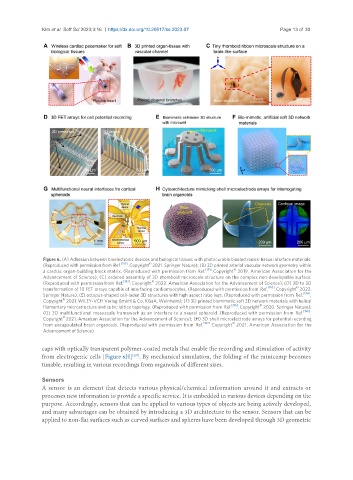
                Figure 6. (A) Adhesion between bioelectronic devices and biological tissues with photocurable bioelectronics-tissue interface materials.
                                                   ©
                (Reproduced with permission from Ref. [105] . Copyright  2021. Springer Nature); (B) 3D printed arterial vascular network geometry within
                                                                                ©
                a cardiac organ-building block matrix. (Reproduced with permission from  Ref. [191] . Copyright  2019. American Association for the
                Advancement of Science); (C) ordered assembly of 3D rhomboid microscale structure on the complex non-developable surface.
                                                    ©
                (Reproduced with permission from  Ref. [192] . Copyright  2022. American Association for the Advancement of Science); (D) 2D to 3D
                                                                                                     ©
                transformation of 10 FET arrays capable of interfacing cardiomyocytes. (Reproduced with permission from  Ref. [193] . Copyright  2022.
                Springer Nature); (E) octopus-shaped cell-laden 3D structures with high aspect ratio legs. (Reproduced with permission from Ref. [194] .
                      ©
                Copyright  2021. WILEY-VCH Verlag GmbH & Co. KGaA, Weinheim); (F) 3D printed biomimetic soft 3D network materials with helical
                                                                               [195]     ©
                filamentary microstructure and cubic lattice topology. (Reproduced with permission from Ref.  . Copyright  2020. Springer Nature);
                                                                                                       [196]
                (G) 3D multifunctional mesoscale framework as an interface to a neural spheroid. (Reproduced with permission from  Ref.  .
                      ©
                Copyright  2021. American Association for the Advancement of Science); (H) 3D shell microelectrode arrays for potential recording
                                                                      [197]    ©
                from encapsulated brain organoids. (Reproduced with permission from  Ref.  . Copyright  2021. American Association for the
                Advancement of Science).
               caps with optically transparent polymer-coated metals that enable the recording and stimulation of activity
                                              [197]
               from electrogenic cells [Figure 6H] . By mechanical simulation, the folding of the minicamp becomes
               tunable, resulting in various recordings from organoids of different sizes.
               Sensors
               A sensor is an element that detects various physical/chemical information around it and extracts or
               processes new information to provide a specific service. It is embedded in various devices depending on the
               purpose. Accordingly, sensors that can be applied to various types of objects are being actively developed,
               and many advantages can be obtained by introducing a 3D architecture to the sensor. Sensors that can be
               applied to non-flat surfaces such as curved surfaces and spheres have been developed through 3D geometric

