


Page 97 - Read Online
P. 97
Kim et al. Soft Sci 2023;3:16  https://dx.doi.org/10.20517/ss.2023.07            Page 9 of 30


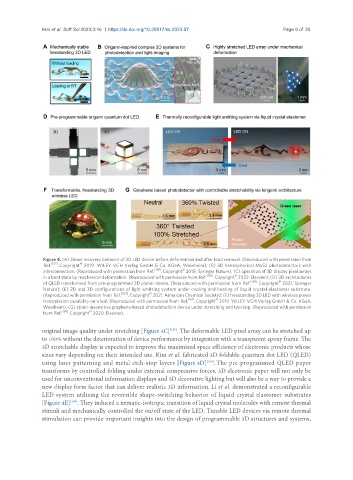
                Figure 4. (A) Shape recovery behavior of 3D LED device before deformation and after load removal. (Reproduced with permission from
                  [157]     ©
                Ref.  . Copyright  2019. WILEY-VCH Verlag GmbH & Co. KGaA, Weinheim); (B) 3D hemispherical MoS2 photodetectors with
                                                     [158]     ©
                interconnection. (Reproduced with permission from Ref.  . Copyright  2018. Springer Nature); (C) operation of 3D display pixel arrays
                                                                       [155]    ©
                in a bent state by mechanical deformation. (Reproduced with permission from Ref.  . Copyright  2022. Elsevier); (D) 3D architectures
                                                                                     [159]     ©
                of QLED transformed from pre-programmed 2D planar device. (Reproduced with permission from  Ref.  . Copyright  2021. Springer
                Nature); (E) 2D and 3D configurations of light emitting system under cooling and heating of liquid crystal elastomer substrate.
                                          [160]    ©
                (Reproduced with permission from Ref.  . Copyright  2021. American Chemical Society); (F) freestanding 3D LED with wireless power
                                                                [161]     ©
                transmission capability on a leaf. (Reproduced with permission from Ref.  . Copyright  2019. WILEY-VCH Verlag GmbH & Co. KGaA,
                Weinheim); (G) strain-insensitive graphene-based photodetection device under stretching and twisting. (Reproduced with permission
                      [156]    ©
                from Ref.  . Copyright  2020. Elsevier).
               original image quality under stretching [Figure 4C] . The deformable LED pixel array can be stretched up
                                                          [155]
               to 100% without the deterioration of device performance by integration with a transparent epoxy frame. The
               3D stretchable display is expected to improve the maximized space efficiency of electronic products whose
               sizes vary depending on their intended use. Kim et al. fabricated 3D foldable quantum dot LED (QLED)
               using laser patterning and metal etch-stop layers [Figure 4D] . The pre-programmed QLED paper
                                                                       [159]
               transforms by controlled folding under external compressive forces. 3D electronic paper will not only be
               used for unconventional information displays and 3D decorative lighting but will also be a way to provide a
               new display form factor that can deliver realistic 3D information. Li et al. demonstrated a reconfigurable
               LED system utilizing the reversible shape-switching behavior of liquid crystal elastomer substrates
               [Figure 4E] . They induced a nematic-isotropic transition of liquid crystal molecules with remote thermal
                         [160]
               stimuli and mechanically controlled the on/off state of the LED. Tunable LED devices via remote thermal
               stimulation can provide important insights into the design of programmable 3D structures and systems,

