


Page 95 - Read Online
P. 95
Kim et al. Soft Sci 2023;3:16  https://dx.doi.org/10.20517/ss.2023.07            Page 7 of 30


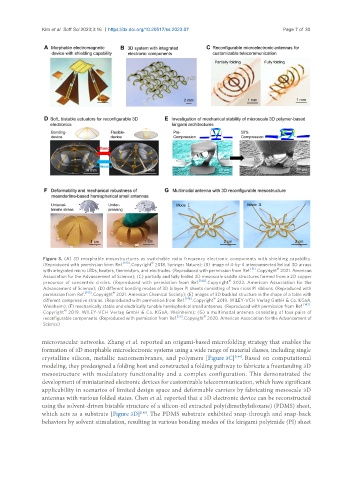
                Figure 3. (A) 3D morphable mesostructures as switchable radio frequency electronic components with shielding capability.
                                                    ©
                (Reproduced with permission from  Ref. [143] . Copyright  2018. Springer Nature); (B) image of 4-by-4 interconnected helical 3D arrays
                                                                                              ©
                with integrated micro LEDs, heaters, thermistors, and electrodes. (Reproduced with permission from Ref. [51] . Copyright  2021. American
                Association for the Advancement of Science); (C) partially and fully folded 3D mesoscale saddle structures formed from a 2D copper
                                                                              ©
                precursor  of  concentric  circles.  (Reproduced  with  permission  from  Ref. [144] . Copyright   2022.  American  Association  for  the
                Advancement of Science); (D) different bonding modes of 3D bilayer PI sheets consisting of two cross PI ribbons. (Reproduced with
                                       ©
                permission from Ref. [145] . Copyright  2021. American Chemical Society); (E) images of 3D buckled structure in the shape of a table with
                                                                         ©
                different compressive strains. (Reproduced with permission from  Ref. [146] . Copyright  2019. WILEY-VCH Verlag GmbH & Co. KGaA,
                Weinheim); (F) mechanically stable and electrically tunable hemispherical small antennas. (Reproduced with permission from Ref. [147] .
                       ©
                Copyright  2019. WILEY-VCH Verlag GmbH & Co. KGaA, Weinheim); (G) a multimodal antenna consisting of four pairs of
                                                                      ©
                reconfigurable components. (Reproduced with permission from Ref. [55] . Copyright  2020. American Association for the Advancement of
                Science)
               microvascular networks. Zhang et al. reported an origami-based microfolding strategy that enables the
               formation of 3D morphable microelectronic systems using a wide range of material classes, including single
                                                                                [144]
               crystalline silicon, metallic nanomembranes, and polymers [Figure 3C] . Based on computational
               modeling, they predesigned a folding host and constructed a folding pathway to fabricate a freestanding 3D
               mesostructure with modulatory functionality and a complex configuration. This demonstrated the
               development of miniaturized electronic devices for customizable telecommunication, which have significant
               applicability in scenarios of limited design space and deformable carriers by fabricating mesoscale 3D
               antennas with various folded states. Chen et al. reported that a 3D electronic device can be reconstructed
               using the solvent-driven bistable structure of a silicon-oil extracted poly(dimethylsiloxane) (PDMS) sheet,
               which acts as a substrate [Figure 3D] . The PDMS substrate exhibited snap-through and snap-back
                                                [145]
               behaviors by solvent stimulation, resulting in various bonding modes of the kirigami polyimide (PI) sheet

