


Page 78 - Read Online
P. 78
Page 8 of 15            Tropiano et al. Mini-invasive Surg 2024;8:17  https://dx.doi.org/10.20517/2574-1225.2024.41


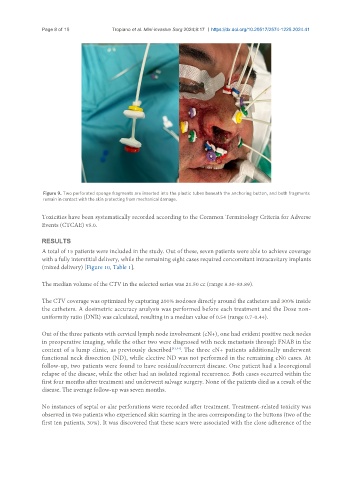
                Figure 9. Two perforated sponge fragments are inserted into the plastic tubes beneath the anchoring button, and both fragments
                remain in contact with the skin protecting from mechanical damage.

               Toxicities have been systematically recorded according to the Common Terminology Criteria for Adverse
               Events (CTCAE) v5.0.


               RESULTS
               A total of 15 patients were included in the study. Out of these, seven patients were able to achieve coverage
               with a fully interstitial delivery, while the remaining eight cases required concomitant intracavitary implants
               (mixed delivery) [Figure 10, Table 1].


               The median volume of the CTV in the selected series was 21.50 cc (range 8.30-83.89).

               The CTV coverage was optimized by capturing 200% isodoses directly around the catheters and 300% inside
               the catheters. A dosimetric accuracy analysis was performed before each treatment and the Dose non-
               uniformity ratio (DNR) was calculated, resulting in a median value of 0.54 (range 0.7-0.44).

               Out of the three patients with cervical lymph node involvement (cN+), one had evident positive neck nodes
               in preoperative imaging, while the other two were diagnosed with neck metastasis through FNAB in the
               context of a lump clinic, as previously described [43,44] . The three cN+ patients additionally underwent
               functional neck dissection (ND), while elective ND was not performed in the remaining cN0 cases. At
               follow-up, two patients were found to have residual/recurrent disease. One patient had a locoregional
               relapse of the disease, while the other had an isolated regional recurrence. Both cases occurred within the
               first four months after treatment and underwent salvage surgery. None of the patients died as a result of the
               disease. The average follow-up was seven months.


               No instances of septal or alar perforations were recorded after treatment. Treatment-related toxicity was
               observed in two patients who experienced skin scarring in the area corresponding to the buttons (two of the
               first ten patients, 30%). It was discovered that these scars were associated with the close adherence of the

