


Page 79 - Read Online
P. 79
Tropiano et al. Mini-invasive Surg 2024;8:17  https://dx.doi.org/10.20517/2574-1225.2024.41  Page 9 of 15


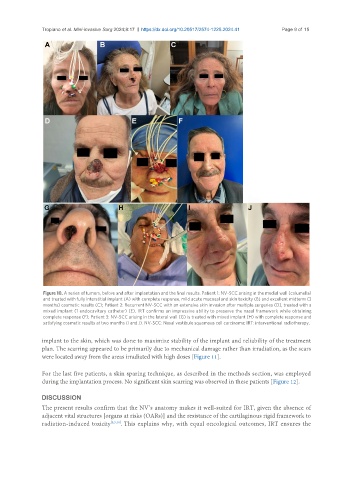
                Figure 10. A series of tumors, before and after implantation and the final results. Patient 1: NV-SCC arising in the medial wall (columella)
                and treated with fully interstitial implant (A) with complete response, mild acute mucosal and skin toxicity (B) and excellent midterm (3
                months) cosmetic results (C); Patient 2: Recurrent NV-SCC with an extensive skin invasion after multiple surgeries (D), treated with a
                mixed implant (1 endocavitary catheter) (E). IRT confirms an impressive ability to preserve the nasal framework while obtaining
                complete response (F); Patient 3: NV-SCC arising in the lateral wall (G) is treated with mixed implant (H) with complete response and
                satisfying cosmetic results at two months (I and J). NV-SCC: Nasal vestibule squamous cell carcinoma; IRT: interventional radiotherapy.

               implant to the skin, which was done to maximize stability of the implant and reliability of the treatment
               plan. The scarring appeared to be primarily due to mechanical damage rather than irradiation, as the scars
               were located away from the areas irradiated with high doses [Figure 11].


               For the last five patients, a skin sparing technique, as described in the methods section, was employed
               during the implantation process. No significant skin scarring was observed in these patients [Figure 12].

               DISCUSSION
               The present results confirm that the NV’s anatomy makes it well-suited for IRT, given the absence of
               adjacent vital structures [organs at risks (OARs)] and the resistance of the cartilaginous rigid framework to
               radiation-induced toxicity [3,5,18] . This explains why, with equal oncological outcomes, IRT ensures the

