


Page 80 - Read Online
P. 80
Page 10 of 15           Tropiano et al. Mini-invasive Surg 2024;8:17  https://dx.doi.org/10.20517/2574-1225.2024.41

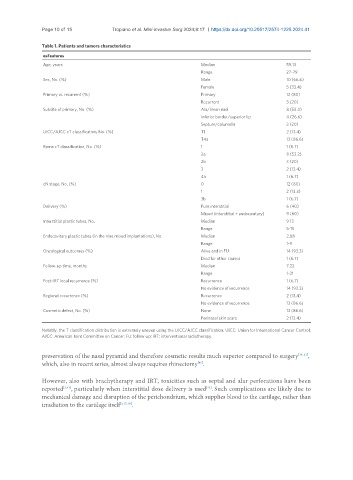
               Table 1. Patients and tumors characteristics
                esFeatures
                Age, years                                           Median                       59.13
                                                                     Range                        27-79
                Sex, No. (%)                                         Male                         10 (66.6)
                                                                     Female                       5 (33.4)
                Primary vs. recurrent (%)                            Primary                      12 (80)
                                                                     Recurrent                    3 (20)
                Subsite of primary, No. (%)                          Ala/limen nasi               8 (53.4)
                                                                     Inferior border/superior lip  4 (26.6)
                                                                     Septum/columella             3 (20)
                UICC/AJCC cT classification, No. (%)                 T1                           2 (13.4)
                                                                     T4a                          13 (86.6)
                Rome cT classification, No. (%)                      1                            1 (6.7)
                                                                     2a                           8 (53.2)
                                                                     2b                           3 (20)
                                                                     3                            2 (13.4)
                                                                     4a                           1 (6.7)
                cN stage, No. (%)                                    0                            12 (80)
                                                                     1                            2 (13.3)
                                                                     3b                           1 (6.7)
                Delivery (%)                                         Pure interstitial            6 (40)
                                                                     Mixed (interstitial + endocavitary)  9 (60)
                Interstitial plastic tubes, No.                      Median                       9.13
                                                                     Range                        5-15
                Endocavitary plastic tubes (in the nine mixed implantations), No.  Median         2.88
                                                                     Range                        1-9
                Oncological outcomes (%)                             Alive and in FU              14 (93.3)
                                                                     Died for other causes        1 (6.7)
                Follow-up time, months                               Median                       7.22
                                                                     Range                        1-21
                Post-IRT local recurrence (%)                        Recurrence                   1 (6.7)
                                                                     No evidence of recurrence    14 (93.3)
                Regional recurrence (%)                              Recurrence                   2 (13.4)
                                                                     No evidence of recurrence    13 (86.6)
                Cosmetic defect, No. (%)                             None                         13 (86.6)
                                                                     Perinasal skin scars         2 (13.4)

               Notably, the T classification distribution is extremely uneven using the UICC/AJCC classification. UICC: Union for International Cancer Control;
               AJCC: American Joint Committee on Cancer; FU: follow-up; IRT: interventional radiotherapy.


               preservation of the nasal pyramid and therefore cosmetic results much superior compared to surgery [16-21] ,
                                                                    [45]
               which, also in recent series, almost always requires rhinectomy .
               However, also with brachytherapy and IRT, toxicities such as septal and alar perforations have been
                                                                      [23]
               reported [3,41] , particularly when interstitial dose delivery is used . Such complications are likely due to
               mechanical damage and disruption of the perichondrium, which supplies blood to the cartilage, rather than
               irradiation to the cartilage itself [3,17,18] .

