


Page 47 - Read Online
P. 47
Aydin et al. J Transl Genet Genom. 2025;9:406-26  https://dx.doi.org/10.20517/jtgg.2025.108                                     Page 414

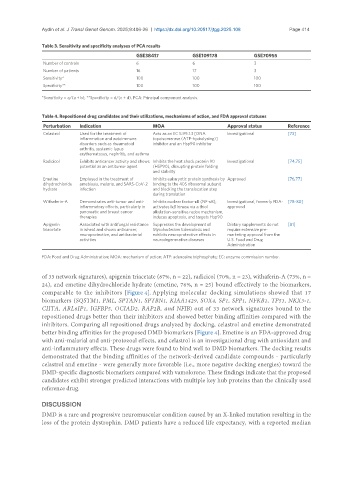
               Table 3. Sensitivity and specificity analyses of PCA results
                                               GSE38417           GSE109178            GSE70955
                Number of controls             6                  6                    3
                Number of patients             16                 17                   3
                Sensitivity*                   100                100                  100
                Specificity**                  100                100                  100
               *Sensitivity = a/(a + b), **Specificity = d/(c + d). PCA: Principal component analysis.


               Table 4. Repositioned drug candidates and their utilizations, mechanisms of action, and FDA approval statuses
                Perturbation  Indication             MOA                      Approval status     Reference
                Celastrol   Used for the treatment of   Acts as an EC 5.99.1.3 [DNA   Investigational  [73]
                            inflammation and autoimmune   topoisomerase (ATP-hydrolysing)]
                            disorders such as rheumatoid   inhibitor and an Hsp90 inhibitor
                            arthritis, systemic lupus
                            erythematosus, nephritis, and asthma
                Radicicol   Exhibits anticancer activity and shows  Inhibits the heat shock protein 90   Investigational  [74,75]
                            potential as an antitumor agent  (HSP90), disrupting protein folding
                                                     and stability
                Emetine     Employed in the treatment of   Inhibits eukaryotic protein synthesis by  Approved  [76,77]
                dihydrochloride   amebiasis, malaria, and SARS-CoV-2  binding to the 40S ribosomal subunit
                hydrate     infection                and blocking the translocation step
                                                     during translation
                Withaferin-A  Demonstrates anti-tumor and anti-  Inhibits nuclear factor-κB (NF-κB),   Investigational, formerly FDA-  [78-80]
                            inflammatory effects, particularly in   activates IκB kinase via a thiol   approved
                            pancreatic and breast cancer   alkylation-sensitive redox mechanism,
                            therapies                induces apoptosis, and targets Hsp90
                Apigenin    Associated with antifungal resistance  Suppresses the development of   Dietary supplements do not   [81]
                triacetate  in wheat and shows anticancer,   Mycobacterium tuberculosis and   require extensive pre-
                            neuroprotective, and antibacterial   exhibits neuroprotective effects in   marketing approval from the
                            activities               neurodegenerative diseases  U.S. Food and Drug
                                                                              Administration

               FDA: Food and Drug Administration; MOA: mechanism of action; ATP: adenosine triphosphate; EC: enzyme commission number.

               of 33 network signatures), apigenin triacetate (67%, n = 22), radicicol (70%, n = 23), withaferin-A (73%, n =
               24), and emetine dihydrochloride hydrate (emetine, 76%, n = 25) bound effectively to the biomarkers,
               comparable to the inhibitors [Figure 4]. Applying molecular docking simulations showed that 17
               biomarkers (SQSTM1, PML, SPTAN1, SPTBN1, KIAA1429, SOX4, SP1, SPP1, NFKB1, TP53, NKX3-1,
               CIITA, ARL6IP1, IGFBP5, OCIAD2, RAP2B, and NFIB) out of 33 network signatures bound to the
               repositioned drugs better than their inhibitors and showed better binding affinities compared with the
               inhibitors. Comparing all repositioned drugs analyzed by docking, celastrol and emetine demonstrated
               better binding affinities for the proposed DMD biomarkers [Figure 4]. Emetine is an FDA-approved drug
               with anti-malarial and anti-protozoal effects, and celastrol is an investigational drug with antioxidant and
               anti-inflammatory effects. These drugs were found to bind well to DMD biomarkers. The docking results
               demonstrated that the binding affinities of the network-derived candidate compounds - particularly
               celastrol and emetine - were generally more favorable (i.e., more negative docking energies) toward the
               DMD-specific diagnostic biomarkers compared with vamolorone. These findings indicate that the proposed
               candidates exhibit stronger predicted interactions with multiple key hub proteins than the clinically used
               reference drug.


               DISCUSSION
               DMD is a rare and progressive neuromuscular condition caused by an X-linked mutation resulting in the
               loss of the protein dystrophin. DMD patients have a reduced life expectancy, with a reported median

