


Page 45 - Read Online
P. 45
Page 413                                                                                                                                      Aydin et al. J Transl Genet Genom. 2025;9:406-26  https://dx.doi.org/10.20517/jtgg.2025.108


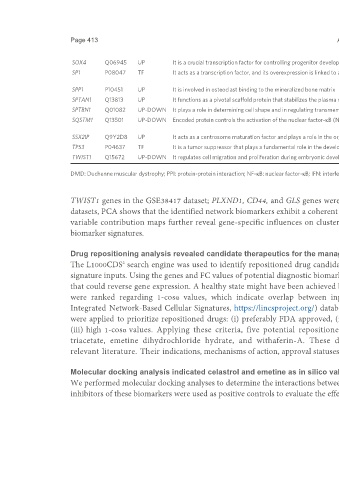
                          SOX4        Q06945     UP           It is a crucial transcription factor for controlling progenitor development, differentiation, and stemness  Amitrole            1639              [63]
                          SP1         P08047     TF           It acts as a transcription factor, and its overexpression is linked to a worse prognosis in many types of cancer  Amitrole      1639              [64,
                                                                                                                                                                                                                65]
                          SPP1        P10451     UP           It is involved in osteoclast binding to the mineralized bone matrix                                         Alandronate         17684448          [66]
                          SPTAN1      Q13813     UP           It functions as a pivotal scaffold protein that stabilizes the plasma membrane and organizes intracellular organelles  Acetaminophen  1983        [67]

                          SPTBN1      Q01082     UP-DOWN      It plays a role in determining cell shape and in regulating transmembrane proteins, cell adhesion, and cell migration  Amitrole  1639             [68]
                          SQSTM1      Q13501     UP-DOWN      Encoded protein controls the activation of the nuclear factor-κB (NF-κB) signaling pathway and binds ubiquitin  1,2-            1322              [69]
                                                                                                                                                                          dimethylhydrazine

                          SSX2IP      Q9Y2D8     UP           It acts as a centrosome maturation factor and plays a role in the organization of cell-cell adherent junctions.  Levofloxacin   149096            [70]
                          TP53        P04637     TF           It is a tumor suppressor that plays a fundamental role in the development of cancer                         Dust                6433340           [71]
                          TWIST1      Q15672     UP-DOWN      It regulates cell migration and proliferation during embryonic development                                  Benzo(a)pyrene      2336              [72]


                          DMD: Duchenne muscular dystrophy; PPI: protein-protein interaction; NF-κB: nuclear factor-κB; IFN: interferon; MHC: major histocompatibility complex.


                          TWIST1 genes in the GSE38417 dataset; PLXND1, CD44, and GLS genes were found in the GSE109178 dataset [Figure 3A-C]. Across all three independent
                          datasets, PCA shows that the identified network biomarkers exhibit a coherent variance structure that distinguishes DMD samples from healthy controls. The

                          variable contribution maps further reveal gene-specific influences on clustering patterns, supporting the robustness and reproducibility of the identified
                          biomarker signatures.


                          Drug repositioning analysis revealed candidate therapeutics for the management of DMD
                                            2
                          The L1000CDS  search engine was used to identify repositioned drug candidates targeting potential diagnostic biomarkers, using log FC values for each as
                                                                                                                                                                                            2
                          signature inputs. Using the genes and FC values of potential diagnostic biomarkers as input, we identified signatures and determined possible drug candidates
                          that could reverse gene expression. A healthy state might have been achieved by reversing the expressions of each biomarker. The resulting drug candidates
                          were  ranked  regarding  1-cosα  values,  which  indicate  overlap  between  input  expression  and  drug-exposed  controls  in  the  LINCS  (The  Library  of
                          Integrated Network-Based Cellular Signatures, https://lincsproject.org/) database. The resultant 50 drugs were selected for further evaluation. Three criteria

                          were applied to prioritize repositioned drugs: (i) preferably FDA approved, (ii) not originally indicated as antineoplastic agents to reduce side effects, and
                          (iii) high 1-cosα values.  Applying  these  criteria,  five  potential  repositioned  drugs  or  small  molecules  were  identified:  celastrol,  radicicol,  apigenin

                          triacetate,  emetine dihydrochloride  hydrate,  and  withaferin-A.  These  drugs  were  comprehensively  searched  in  PubChem,  DrugBank,  and  the
                          relevant literature. Their indications, mechanisms of action, approval statuses, and prior reports related to DMD are summarized in Table 4.


                          Molecular docking analysis indicated celastrol and emetine as in silico validated repositioned drug candidates
                          We performed molecular docking analyses to determine the interactions between selected drugs and DMD-specific diagnostic biomarkers. Binding affinities of
                          inhibitors of these biomarkers were used as positive controls to evaluate the effectiveness of the selected drugs. Among the five drugs, celastrol (91%, n = 30 out

