


Page 49 - Read Online
P. 49
Aydin et al. J Transl Genet Genom. 2025;9:406-26  https://dx.doi.org/10.20517/jtgg.2025.108                                     Page 416


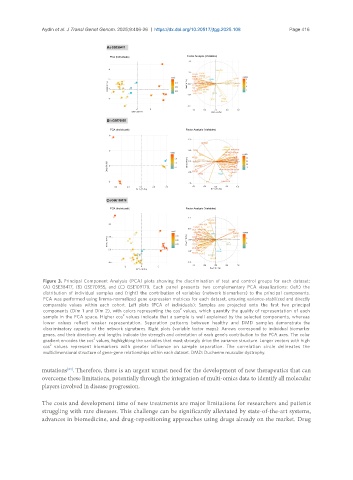
                Figure  3.  Principal  Component  Analysis  (PCA)  plots  showing  the  discrimination  of  test  and  control  groups  for  each  dataset:
                (A)  GSE38417,  (B)  GSE70955,  and  (C)  GSE109178.  Each  panel  presents  two complementary  PCA  visualizations:  (left)  the
                distribution  of  individual  samples  and  (right)  the  contribution  of  variables  (network biomarkers)  to  the  principal  components.
                PCA was performed using limma-normalized gene expression matrices for each dataset, ensuring variance-stabilized and directly
                comparable  values  within  each  cohort.  Left  plots  (PCA  of  individuals):  Samples  are  projected onto  the  first  two  principal
                                                              2
                components (Dim 1 and Dim 2), with colors representing the cos  values, which quantify the quality of representation  of  each
                                          2
                sample in the PCA space. Higher cos  values indicate that a sample is well explained by the selected components,  whereas
                lower  values  reflect  weaker  representation.  Separation  patterns  between  healthy  and  DMD  samples demonstrate  the
                discriminatory  capacity  of  the  network  signatures.  Right  plots  (variable  factor  maps):  Arrows  correspond  to  individual biomarker
                genes, and their directions and lengths indicate the strength and orientation of each gene’s contribution to the PCA axes. The color
                                 2
                gradient encodes the cos  values, highlighting the variables that most strongly drive the variance structure. Longer vectors with high
                  2
                cos   values  represent  biomarkers  with  greater  influence  on  sample  separation.  The  correlation  circle  delineates  the
                multidimensional structure of gene-gene relationships within each dataset. DMD: Duchenne muscular dystrophy.
                        [84]
               mutations . Therefore, there is an urgent unmet need for the development of new therapeutics that can
               overcome these limitations, potentially through the integration of multi-omics data to identify all molecular
               players involved in disease progression.


               The costs and development time of new treatments are major limitations for researchers and patients
               struggling with rare diseases. This challenge can be significantly alleviated by state-of-the-art systems,
               advances in biomedicine, and drug-repositioning approaches using drugs already on the market. Drug

