


Page 51 - Read Online
P. 51
Page 10 of 18                        Li et al. J. Mater. Inf. 2025, 5, 29  https://dx.doi.org/10.20517/jmi.2024.103

                         2
               Table 3. The R  score of each SR method on SR4Real dataset
                SR algorithm                         E2E               DSO              uDSR
                Base                                 0.880             1.000            1.000
                Ops                                  0.129             0.617            0.901
                Dummy                                0.944             0.880            0.999
                Noise                                -0.115            0.647            0.643
                Num                                  0.833             1.000            1.000
                Domain                               0.476             0.732            0.398
                Average                              0.525             0.813            0.824

                2
               R : Coefficient of determination; SR: symbolic regression; E2E: end-to-end symbolic regression; DSO: deep symbolic optimization; uDSR: unified
               deep symbolic regression.

               Table 4. The NED of each SR method on SR4Real dataset
                SR algorithm                     E2E                  DSO               uDSR
                Base                             65.500               3.300             10.500
                Ops                              205.500              15.833            132.333
                Dummy                            269.400              17.000            26.700
                Noise                            74.600               16.400            70.700
                Num                              48.400               4.600             12.000
                Domain                           132.667              10.167            17.667
                Average                          132.678              11.217            44.983

               NED: Normalized edit distance; SR: symbolic regression; E2E: end-to-end symbolic regression; DSO: deep symbolic optimization; uDSR: unified
               deep symbolic regression.


                                                                                  2
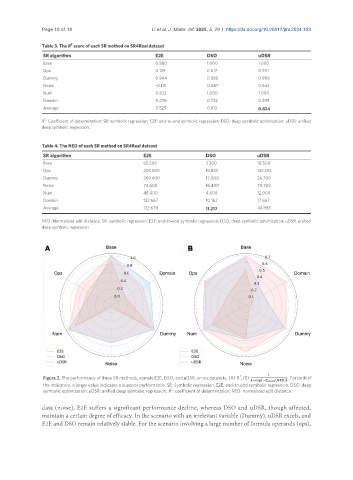
                Figure 2. The performance of three SR methods, namely E2E, DSO, and uDSR, on six datasets. (A) R , (B) 1+exp(-Z score (NED)). For both of
                the indicators, a larger value indicates a superior performance. SR: Symbolic regression; E2E: end-to-end symbolic regression; DSO: deep
                                                           2
                symbolic optimization; uDSR: unified deep symbolic regression; R : coefficient of determination; NED: normalized edit distance.
               data (noise), E2E suffers a significant performance decline, whereas DSO and uDSR, though affected,
               maintain a certain degree of efficacy. In the scenario with an irrelevant variable (Dummy), uDSR excels, and
               E2E and DSO remain relatively stable. For the scenario involving a large number of formula operands (ops),

