


Page 55 - Read Online
P. 55
Page 14 of 18                        Li et al. J. Mater. Inf. 2025, 5, 29  https://dx.doi.org/10.20517/jmi.2024.103


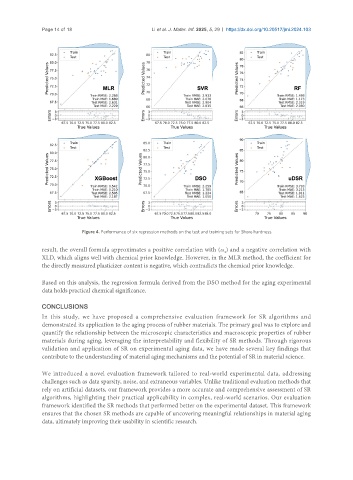
                             Figure 4. Performance of six regression methods on the test and training sets for Shore hardness.


               result, the overall formula approximates a positive correlation with (ω ) and a negative correlation with
                                                                             4
               XLD, which aligns well with chemical prior knowledge. However, in the MLR method, the coefficient for
               the directly measured plasticizer content is negative, which contradicts the chemical prior knowledge.


               Based on this analysis, the regression formula derived from the DSO method for the aging experimental
               data holds practical chemical significance.


               CONCLUSIONS
               In this study, we have proposed a comprehensive evaluation framework for SR algorithms and
               demonstrated its application to the aging process of rubber materials. The primary goal was to explore and
               quantify the relationship between the microscopic characteristics and macroscopic properties of rubber
               materials during aging, leveraging the interpretability and flexibility of SR methods. Through rigorous
               validation and application of SR on experimental aging data, we have made several key findings that
               contribute to the understanding of material aging mechanisms and the potential of SR in material science.


               We introduced a novel evaluation framework tailored to real-world experimental data, addressing
               challenges such as data sparsity, noise, and extraneous variables. Unlike traditional evaluation methods that
               rely on artificial datasets, our framework provides a more accurate and comprehensive assessment of SR
               algorithms, highlighting their practical applicability in complex, real-world scenarios. Our evaluation
               framework identified the SR methods that performed better on the experimental dataset. This framework
               ensures that the chosen SR methods are capable of uncovering meaningful relationships in material aging
               data, ultimately improving their usability in scientific research.

