


Page 56 - Read Online
P. 56
Li et al. J. Mater. Inf. 2025, 5, 29  https://dx.doi.org/10.20517/jmi.2024.103  Page 15 of 18

               Table 8. The formula obtained for MLR, DSO, and uDSR under the Fe task
                Algorithm       Formula
                MLR             Fe = 0.347·ω  - 1.820·ω  - 0.233·XLD - 0.006·LC  + 1.748
                                         1
                                               2
                                                              p
                DSO             Fe = ω  + -ω ω ω exp(-ω )-ω +exp(exp(ω ))
                                     4  4  4  4  4  4      4
                uDSR            Fe = exp (ω  + (-μ - ln(XLD) + 1.000)·exp (ω ·exp (μ )))
                                        3  2                3    3
               For the definitions of the variables, please refer to Table 2. The constant coefficient has been rounded to three decimal places. MLR: Multiple
               linear regression; DSO: deep symbolic optimization; uDSR: unified deep symbolic regression; XLD: crosslink density.


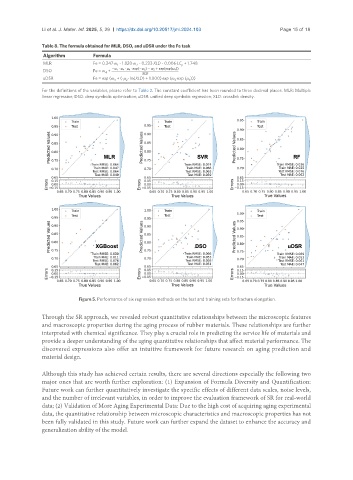
                            Figure 5. Performance of six regression methods on the test and training sets for fracture elongation.


               Through the SR approach, we revealed robust quantitative relationships between the microscopic features
               and macroscopic properties during the aging process of rubber materials. These relationships are further
               interpreted with chemical significance. They play a crucial role in predicting the service life of materials and
               provide a deeper understanding of the aging quantitative relationships that affect material performance. The
               discovered expressions also offer an intuitive framework for future research on aging prediction and
               material design.


               Although this study has achieved certain results, there are several directions especially the following two
               major ones that are worth further exploration: (1) Expansion of Formula Diversity and Quantification:
               Future work can further quantitatively investigate the specific effects of different data scales, noise levels,
               and the number of irrelevant variables, in order to improve the evaluation framework of SR for real-world
               data; (2) Validation of More Aging Experimental Data: Due to the high cost of acquiring aging experimental
               data, the quantitative relationship between microscopic characteristics and macroscopic properties has not
               been fully validated in this study. Future work can further expand the dataset to enhance the accuracy and
               generalization ability of the model.

