


Page 53 - Read Online
P. 53
Page 12 of 18                        Li et al. J. Mater. Inf. 2025, 5, 29  https://dx.doi.org/10.20517/jmi.2024.103


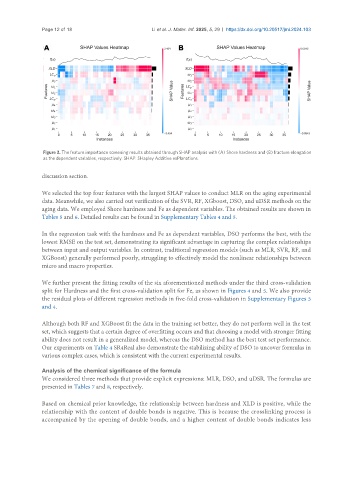
                Figure 3. The feature importance screening results obtained through SHAP analysis with (A) Shore hardness and (B) fracture elongation
                as the dependent variables, respectively. SHAP: SHapley Additive exPlanations.

               discussion section.


               We selected the top four features with the largest SHAP values to conduct MLR on the aging experimental
               data. Meanwhile, we also carried out verification of the SVR, RF, XGboost, DSO, and uDSR methods on the
               aging data. We employed Shore hardness and Fe as dependent variables. The obtained results are shown in
               Tables 5 and 6. Detailed results can be found in Supplementary Tables 4 and 5.

               In the regression task with the hardness and Fe as dependent variables, DSO performs the best, with the
               lowest RMSE on the test set, demonstrating its significant advantage in capturing the complex relationships
               between input and output variables. In contrast, traditional regression models (such as MLR, SVR, RF, and
               XGBoost) generally performed poorly, struggling to effectively model the nonlinear relationships between
               micro and macro properties.


               We further present the fitting results of the six aforementioned methods under the third cross-validation
               split for Hardness and the first cross-validation split for Fe, as shown in Figures 4 and 5. We also provide
               the residual plots of different regression methods in five-fold cross-validation in Supplementary Figures 3
               and 4.

               Although both RF and XGBoost fit the data in the training set better, they do not perform well in the test
               set, which suggests that a certain degree of overfitting occurs and that choosing a model with stronger fitting
               ability does not result in a generalized model, whereas the DSO method has the best test set performance.
               Our experiments on Table 4 SR4Real also demonstrate the stabilizing ability of DSO to uncover formulas in
               various complex cases, which is consistent with the current experimental results.


               Analysis of the chemical significance of the formula
               We considered three methods that provide explicit expressions: MLR, DSO, and uDSR. The formulas are
               presented in Tables 7 and 8, respectively.


               Based on chemical prior knowledge, the relationship between hardness and XLD is positive, while the
               relationship with the content of double bonds is negative. This is because the crosslinking process is
               accompanied by the opening of double bonds, and a higher content of double bonds indicates less

