


Page 46 - Read Online
P. 46
Li et al. J. Mater. Inf. 2025, 5, 29  https://dx.doi.org/10.20517/jmi.2024.103   Page 5 of 18


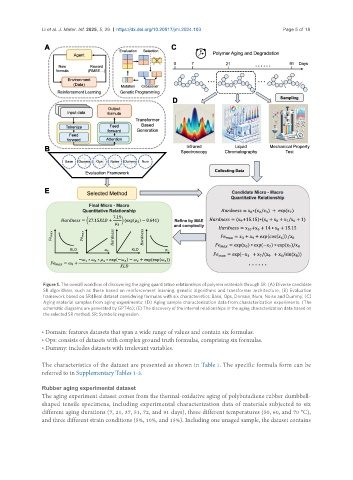
                Figure 1. The overall workflow of discovering the aging quantitative relationships of polymer materials through SR. (A) Diverse candidate
                SR algorithms, such as those based on reinforcement learning, genetic algorithms and transformer architecture; (B) Evaluation
                framework based on SR4Real dataset considering formulas with six characteristics: Base, Ops, Domain, Num, Noise and Dummy; (C)
                Aging material samples from aging experiments; (D) Aging sample characterization data from characterization experiments. (The
                schematic diagrams are generated by GPT4o); (E) The discovery of the internal relationships in the aging characterization data based on
                the selected SR method. SR: Symbolic regression.

               • Domain: features datasets that span a wide range of values and contain six formulas.
               • Ops: consists of datasets with complex ground truth formulas, comprising six formulas.
               • Dummy: includes datasets with irrelevant variables.


               The characteristics of the dataset are presented as shown in Table 1. The specific formula form can be
               referred to in Supplementary Tables 1-3.

               Rubber aging experimental dataset
               The aging experiment dataset comes from the thermal-oxidative aging of polybutadiene rubber dumbbell-
               shaped tensile specimens, including experimental characterization data of materials subjected to six
               different aging durations (7, 21, 37, 51, 72, and 91 days), three different temperatures (50, 60, and 70 °C),
               and three different strain conditions (5%, 10%, and 15%). Including one unaged sample, the dataset contains

