


Page 35 - Read Online
P. 35
Page 12 of 18                      Liu et al. J. Mater. Inf. 2025, 5, 27  I http://dx.doi.org/10.20517/jmi.2024.105


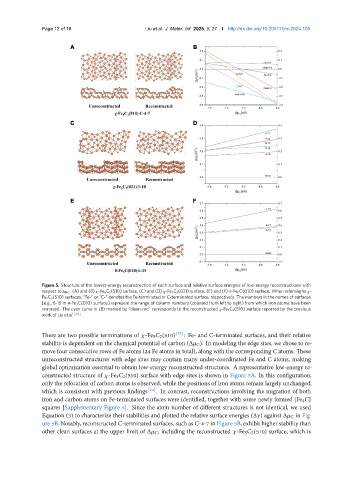
               Figure 5. Structure of the lowest-energy reconstruction of each surface and relative surface energies of low-energy reconstructions with
               respect to Δ   C . (A) and (B)   -Fe 5C 2(510) surface, (C) and (D)   -Fe 5C 2(021) surface, (E) and (F)   -Fe 3C(010) surface. When referring to   -
               Fe 5C 2(510) surfaces, “Fe-” or “C-” denotes the Fe-terminated or C-terminated surface, respectively. The numbers in the names of surfaces
               [e.g., 6-15 in   -Fe 3C(010) surface] represent the range of column numbers (counted from left to right) from which iron atoms have been
               removed. The cyan curve in (B) marked by “clean-rec” corresponds to the reconstructed   -Fe 5C 2(510) surface reported by the previous
               work of Liu et al.  [24] .


               There are two possible terminations of   -Fe 5C 2(510) [75] : Fe- and C-terminated surfaces, and their relative
               stability is dependent on the chemical potential of carbon (Δ   C). In modeling the edge sites, we chose to re-
               move four consecutive rows of Fe atoms (24 Fe atoms in total), along with the corresponding C atoms. These
               unreconstructed structures with edge sites may contain many under-coordinated Fe and C atoms, making
               global optimization essential to obtain low-energy reconstructed structures. A representative low-energy re-
               constructed structure of   -Fe 5C 2(510) surface with edge sites is shown in Figure 5A. In this configuration,
               only the relocation of carbon atoms is observed, while the positions of iron atoms remain largely unchanged,
               which is consistent with previous findings [24] . In contrast, reconstructions involving the migration of both
               iron and carbon atoms on Fe-terminated surfaces were identified, together with some newly formed [Fe 4C]
               squares [Supplementary Figure 5]. Since the atom number of different structures is not identical, we used
               Equation (3) to characterize their stabilities and plotted the relative surface energies (Δ  ) against Δ   C in Fig-
               ure 5B. Notably, reconstructed C-terminated surfaces, such as C-4-7 in Figure 5B, exhibit higher stability than
               other clean surfaces at the upper limit of Δ   C, including the reconstructed   -Fe 5C 2(510) surface, which is

