


Page 36 - Read Online
P. 36
Liu et al. J. Mater. Inf. 2025, 5, 27  I http://dx.doi.org/10.20517/jmi.2024.105  Page 13 of 18


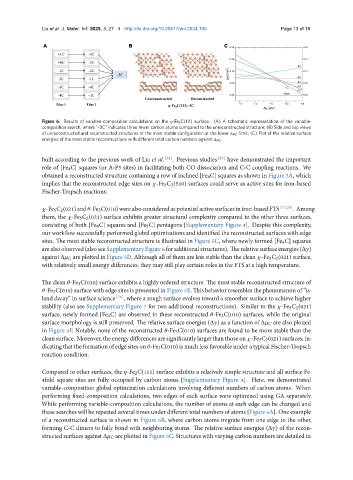
               Figure 6. Results of variable-composition calculations on the   -Fe 2C(111) surface. (A) A schematic representation of the variable-
               composition search, where “-3C” indicates three fewer carbon atoms compared to the unreconstructed structure; (B) Side and top views
               of unreconstructed and reconstructed structures of the most stable configuration at the lower Δ   C limit; (C) Plot of the relative surface
               energies of the most stable reconstructions with different total carbon numbers against Δ   C .


               built according to the previous work of Liu et al. [24] . Previous studies [25]  have demonstrated the important
               role of [Fe 4C] squares (or A-P5 sites) in facilitating both CO dissociation and C-C coupling reactions. We
               obtained a reconstructed structure containing a row of inclined [Fe 4C] squares as shown in Figure 5A, which
               implies that the reconstructed edge sites on   -Fe 5C 2(510) surfaces could serve as active sites for iron-based
               Fischer-Tropsch reactions.

                 -Fe 5C 2(021)and   -Fe 3C(010)werealsoconsideredaspotentialactivesurfacesiniron-basedFTS [17,25] . Among
               them, the   -Fe 5C 2(021) surface exhibits greater structural complexity compared to the other three surfaces,
               consisting of both [Fe 4C] squares and [Fe 5C] pentagons [Supplementary Figure 4]. Despite this complexity,
               our workflow successfully performed global optimizations and identified the reconstructed surfaces with edge
               sites. The most stable reconstructed structure is illustrated in Figure 5C, where newly formed [Fe 4C] squares
               arealsoobserved(alsoseeSupplementaryFigure6foradditionalstructures). Therelativesurfaceenergies(Δ  )
               against Δ   C are plotted in Figure 5D. Although all of them are less stable than the clean   -Fe 5C 2(021) surface,
               with relatively small energy differences, they may still play certain roles in the FTS at a high temperature.


               The clean   -Fe 3C(010) surface exhibits a highly ordered structure. The most stable reconstructed structure of
                 -Fe 3C(010) surface with edge sites is presented in Figure 5E. This behavior resembles the phenomenon of “is-
               land decay” in surface science [76] , where a rough surface evolves toward a smoother surface to achieve higher
               stability (also see Supplementary Figure 7 for two additional reconstructions). Similar to the   -Fe 5C 2(021)
               surface, newly formed [Fe 4C] are observed in these reconstructed   -Fe 3C(010) surfaces, while the original
               surface morphology is still preserved. The relative surface energies (Δ  ) as a function of Δ   C are also plotted
               in Figure 5F. Notably, none of the reconstructed   -Fe 3C(010) surfaces are found to be more stable than the
               cleansurface. Moreover, theenergydifferencesaresignificantlylargerthanthoseon   -Fe 5C 2(021)surfaces, in-
               dicating that the formation of edge sites on   -Fe 3C(010) is much less favorable under a typical Fischer-Tropsch
               reaction condition.

               Compared to other surfaces, the   -Fe 2C(111) surface exhibits a relatively simple structure and all surface Fe-
               4fold square sites are fully occupied by carbon atoms [Supplementary Figure 4]. Here, we demonstrated
               variable-composition global optimization calculations involving different numbers of carbon atoms. When
               performing fixed-composition calculations, two edges of each surface were optimized using GA separately.
               While performing variable-composition calculations, the number of atoms at each edge can be changed and
               these searches will be repeated several times under different total numbers of atoms [Figure 6A]. One example
               of a reconstructed surface is shown in Figure 6B, where carbon atoms migrate from one edge to the other,
               forming C-C dimers to fully bond with neighboring atoms. The relative surface energies (Δ  ) of the recon-
               structed surfaces against Δ   C are plotted in Figure 6C. Structures with varying carbon numbers are detailed in

