


Page 30 - Read Online
P. 30
Liu et al. J. Mater. Inf. 2025, 5, 27  I http://dx.doi.org/10.20517/jmi.2024.105  Page 7 of 18

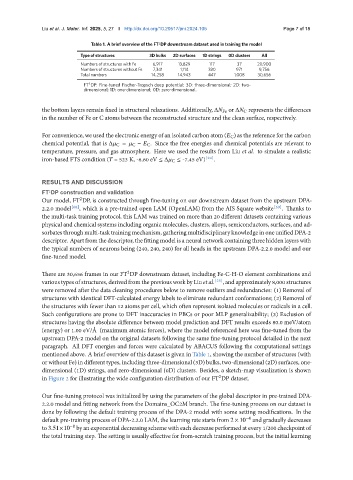
                                Table 1. A brief overview of the FT DP downstream dataset used in training the model
                                                       2
                            Type of structures     3D bulks  2D surfaces  1D strings  0D clusters  All
                            Numbers of structures with Fe  6,917  13,829  117    37     20,900
                            Numbers of structures without Fe  7,341  1,114  330  971    9,756
                            Total numbers           14,258   14,943    447      1,008   30,656
                               2
                             FT DP: Fine-tuned Fischer-Tropsch deep potential; 3D: three-dimensional; 2D: two-
                             dimensional; 1D: one-dimensional; 0D: zero-dimensional.

               the bottom layers remain fixed in structural relaxations. Additionally, Δ   Fe or Δ   C represents the differences
               in the number of Fe or C atoms between the reconstructed structure and the clean surface, respectively.


               For convenience, we used the electronic energy of an isolated carbon atom (   C) as the reference for the carbon
               chemical potential, that is Δ   C =    C −    C. Since the free energies and chemical potentials are relevant to
               temperature, pressure, and gas atmosphere. Here we used the results from Liu et al. to simulate a realistic
               iron-based FTS condition (   = 523 K, -6.60 eV ≤ Δ   C ≤ -7.45 eV) [24] .


               RESULTS AND DISCUSSION
               FT DP construction and validation
                 2
               Our model, FT DP, is constructed through fine-tuning on our downstream dataset from the upstream DPA-
                            2
               2.2.0 model [68] , which is a pre-trained open LAM (OpenLAM) from the AIS Square website [69] . Thanks to
               the multi-task training protocol, this LAM was trained on more than 20 different datasets containing various
               physical and chemical systems including organic molecules, clusters, alloys, semiconductors, surfaces, and ad-
               sorbates through multi-task training mechanism, gathering multidisciplinary knowledge in one unified DPA-2
               descriptor. Apart from the descriptor, the fitting model is a neural network containing three hidden layers with
               the typical numbers of neurons being (240, 240, 240) for all heads in the upstream DPA-2.2.0 model and our
               fine-tuned model.


               There are 30,656 frames in our FT DP downstream dataset, including Fe-C-H-O element combinations and
                                            2
               various types of structures, derived from the previous work by Liu etal. [25] , and approximately 8,000 structures
               were removed after the data cleaning procedures below to remove outliers and redundancies: (1) Removal of
               structures with identical DFT-calculated energy labels to eliminate redundant conformations; (2) Removal of
               the structures with fewer than 12 atoms per cell, which often represent isolated molecules or radicals in a cell.
               Such configurations are prone to DFT inaccuracies in PBCs or poor MLP generalizability; (3) Exclusion of
               structures having the absolute difference between model prediction and DFT results exceeds 80.0 meV/atom
               (energy) or 1.00 eV/Å (maximum atomic forces), where the model referenced here was fine-tuned from the
               upstream DPA-2 model on the original datasets following the same fine-tuning protocol detailed in the next
               paragraph. All DFT energies and forces were calculated by ABACUS following the computational settings
               mentioned above. A brief overview of this dataset is given in Table 1, showing the number of structures (with
               or without Fe) in different types, including three-dimensional (3D) bulks, two-dimensional (2D) surfaces, one-
               dimensional (1D) strings, and zero-dimensional (0D) clusters. Besides, a sketch-map visualization is shown
               in Figure 2 for illustrating the wide configuration distribution of our FT DP dataset.
                                                                           2
               Our fine-tuning protocol was initialized by using the parameters of the global descriptor in pre-trained DPA-
               2.2.0 model and fitting network from the Domains_OC2M branch. The fine-tuning process on our dataset is
               done by following the default training process of the DPA-2 model with some setting modifications. In the
               default pre-training process of DPA-2.2.0 LAM, the learning rate starts from 2 × 10 and gradually decreases
                                                                                    −4
               to 3.51×10 by an exponential decreasing scheme with each decrease performed at every 1/200 checkpoint of
                         −8
               the total training step. The setting is usually effective for from-scratch training process, but the initial learning

