


Page 29 - Read Online
P. 29
Page 6 of 18                       Liu et al. J. Mater. Inf. 2025, 5, 27  I http://dx.doi.org/10.20517/jmi.2024.105


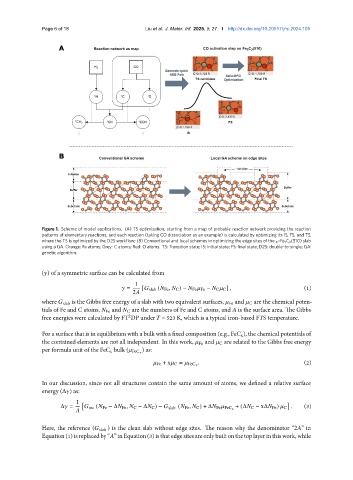
               Figure 1. Scheme of model applications. (A) TS optimization, starting from a map of probable reaction network providing the reaction
               patterns of elementary reactions, and each reaction (taking CO dissociation as an example) is calculated by optimizing its IS, FS, and TS,
               where the TS is optimized by the D2S workflow; (B) Conventional and local schemes in optimizing the edge sites of the   -Fe 5C 2(510) slab
               using a GA. Orange: Fe atoms; Grey: C atoms; Red: O atoms. TS: Transition state; IS: initial state; FS: final state; D2S: double-to-single; GA:
               genetic algorithm.


               (  ) of a symmetric surface can be calculated from
                                              1
                                             =   [   slab (   Fe ,    C ) −    Fe    Fe −    C    C ] ,  (1)
                                              2
               where    slab is the Gibbs free energy of a slab with two equivalent surfaces,    Fe and    C are the chemical poten-
               tials of Fe and C atoms,    Fe and    C are the numbers of Fe and C atoms, and    is the surface area. The Gibbs
               free energies were calculated by FT DP under    = 523 K, which is a typical iron-based FTS temperature.
                                            2
               For a surface that is in equilibrium with a bulk with a fixed composition (e.g., FeC x), the chemical potentials of
               the contained elements are not all independent. In this work,    Fe and    C are related to the Gibbs free energy
                                                 ) as:
               per formula unit of the FeC    bulk (   FeC
                                                                    .                                   (2)
                                                        Fe + x   C =    FeC

               In our discussion, since not all structures contain the same amount of atoms, we defined a relative surface
               energy (Δ  ) as:
                           1 [                                                                    ]
                     Δ   =      rec (   Fe − Δ   Fe ,    C − Δ   C ) −    slab (   Fe ,    C ) + Δ   Fe    FeC x  + (Δ   C − xΔ   Fe )    C .  (3)


               Here, the reference (   slab ) is the clean slab without edge sites. The reason why the denominator “2  ” in
               Equation(1)isreplacedby“  ”inEquation(3)isthatedgesitesareonlybuiltonthetoplayerinthiswork,while

