


Page 22 - Read Online
P. 22
Li et al. J Mater Inf 2024;4:27  https://dx.doi.org/10.20517/jmi.2024.44        Page 15 of 20


               Discussion
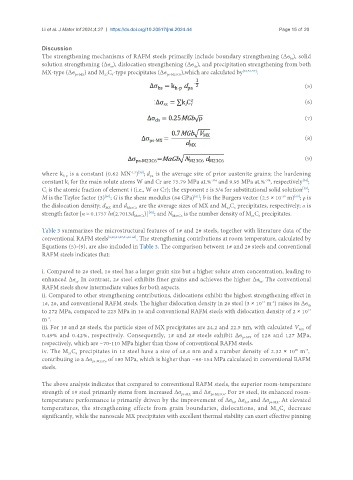
               The strengthening mechanisms of RAFM steels primarily include boundary strengthening (∆σ ), solid
                                                                                                   bs
               solution strengthening (∆σ ), dislocation strengthening (∆σ ), and precipitation strengthening from both
                                      ss
                                                                  ds
               MX-type (∆σ ps-MX ) and M C -type precipitates (∆σ ps-M23C6 ),which are calculated by [48,54-57] :
                                    23 6
                                                                                                        (5)

                                                                                                        (6)

                                                                                                        (7)


                                                                                                        (8)


                                                                                                        (9)


                                             -1.5 [58]
               where k  is a constant (0.62 MN ) ; d  is the average size of prior austenite grains; the hardening
                                                    pa
                      h-p
               constant k for the main solute atoms W and Cr are 75.79 MPa at.%  and 9.95 MPa at.% , respectively ;
                                                                                                       [54]
                                                                        -3/4
                                                                                          -3/4
                        i
               C is the atomic fraction of element i (i.e., W or Cr); the exponent z is 3/4 for substitutional solid solution ;
                                                                                                       [59]
                 i
               M is the Taylor factor (3) ; G is the shear modulus (84 GPa) ; b is the Burgers vector (2.5 × 10  m) ; ρ is
                                    [60]
                                                                   [61]
                                                                                                    [60]
                                                                                                -10
               the dislocation density; d  and d M23C6  are the average sizes of MX and M C  precipitates, respectively; α is
                                     MX
                                                                                6
                                                                             23
                                                   [62]
               strength factor [α ≈ 0.1757 ln(2.7013d M23C6 )] ; and N M23C6  is the number density of M C  precipitates.
                                                                                      23 6
               Table 3 summarizes the microstructural features of 1# and 2# steels, together with literature data of the
               conventional RAFM steels [6,20,21,27,51,63-66] . The strengthening contributions at room temperature, calculated by
               Equations (5)-(9), are also included in Table 3. The comparison between 1# and 2# steels and conventional
               RAFM steels indicates that:
               i. Compared to 2# steel, 1# steel has a larger grain size but a higher solute atom concentration, leading to
               enhanced ∆σ . In contrast, 2# steel exhibits finer grains and achieves the higher ∆σ . The conventional
                                                                                        bs
                          ss
               RAFM steels show intermediate values for both aspects.
               ii. Compared to other strengthening contributions, dislocations exhibit the highest strengthening effect in
               1#, 2#, and conventional RAFM steels. The higher dislocation density in 2# steel (3 × 10  m ) raises its ∆σ
                                                                                             -2
                                                                                         14
                                                                                                         ds
               to 272 MPa, compared to 223 MPa in 1# and conventional RAFM steels with dislocation density of 2 × 10
                                                                                                         14
               m .
                 -2
               iii. For 1# and 2# steels, the particle sizes of MX precipitates are 24.2 and 22.5 nm, with calculated V  of
                                                                                                      MX
               0.49% and 0.42%, respectively. Consequently, 1# and 2# steels exhibit ∆σ ps-MX  of 128 and 127 MPa,
               respectively, which are ~70-110 MPa higher than those of conventional RAFM steels.
               iv. The M C  precipitates in 1# steel have a size of 48.4 nm and a number density of 2.32 × 10  m ,
                                                                                                    20
                                                                                                        -3
                        23
                           6
               contributing to a ∆σ ps-M23C6  of 180 MPa, which is higher than ~98-154 MPa calculated in conventional RAFM
               steels.
               The above analysis indicates that compared to conventional RAFM steels, the superior room-temperature
               strength of 1# steel primarily stems from increased ∆σ ps-MX  and ∆σ ps-M23C6 . For 2# steel, its enhanced room-
               temperature performance is primarily driven by the improvement of ∆σ , ∆σ , and ∆σ ps-MX . At elevated
                                                                               bs
                                                                                   ds
               temperatures, the strengthening effects from grain boundaries, dislocations, and M C  decrease
                                                                                              23
                                                                                                 6
               significantly, while the nanoscale MX precipitates with excellent thermal stability can exert effective pinning

