


Page 21 - Read Online
P. 21
Page 14 of 20                           Li et al. J Mater Inf 2024;4:27  https://dx.doi.org/10.20517/jmi.2024.44


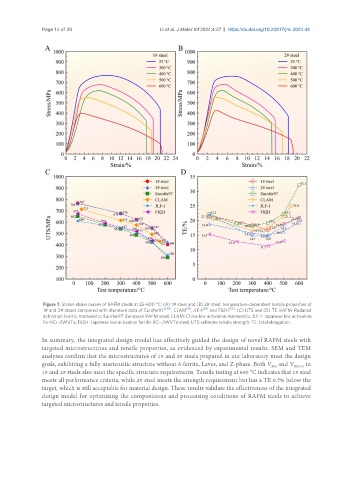
                Figure 7. Stress-strain curves of RAFM steels at 25-600 °C: (A) 1# steel and (B) 2# steel; temperature-dependent tensile properties of
                1# and 2# steels compared with literature data of Eurofer97 [1,50] , CLAM [51] , JLF-1 [52]  and F82H [53] : (C) UTS and (D) TE. RAFM: Reduced
                activation ferritic-martensitic; Eurofer97: European RAFM steel; CLAM: China low activation martensitic; JLF-1: Japanese low activation
                Fe–9Cr–2WVTa; F82H: Japanese low activation ferritic 8Cr–2WVTa steel; UTS: ultimate tensile strength; TE: total elongation.


               In summary, the integrated design model has effectively guided the design of novel RAFM steels with
               targeted microstructures and tensile properties, as evidenced by experimental results. SEM and TEM
               analyses confirm that the microstructures of 1# and 2# steels prepared in our laboratory meet the design
               goals, exhibiting a fully martensitic structure without δ-ferrite, Laves, and Z-phase. Both V  and V M23C6  in
                                                                                             MX
               1# and 2# steels also meet the specific structure requirements. Tensile testing at 600 °C indicates that 1# steel
               meets all performance criteria, while 2# steel meets the strength requirement but has a TE 0.7% below the
               target, which is still acceptable for material design. These results validate the effectiveness of the integrated
               design model for optimizing the compositions and processing conditions of RAFM steels to achieve
               targeted microstructures and tensile properties.

