


Page 20 - Read Online
P. 20
Li et al. J Mater Inf 2024;4:27  https://dx.doi.org/10.20517/jmi.2024.44        Page 13 of 20


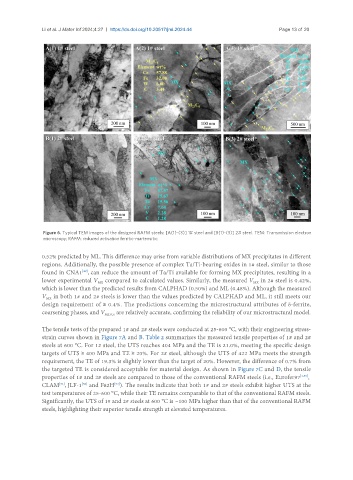
                Figure 6. Typical TEM images of the designed RAFM steels: [A(1)-(3)] 1# steel and [B(1)-(3)] 2# steel. TEM: Transmission electron
                microscopy; RAFM: reduced activation ferritic-martensitic.

               0.52% predicted by ML. This difference may arise from variable distributions of MX precipitates in different
               regions. Additionally, the possible presence of complex Ta/Ti-bearing oxides in 1# steel, similar to those
                             [49]
               found in CNA1 , can reduce the amount of Ta/Ti available for forming MX precipitates, resulting in a
               lower experimental V  compared to calculated values. Similarly, the measured V  in 2# steel is 0.42%,
                                  MX
                                                                                      MX
               which is lower than the predicted results from CALPHAD (0.50%) and ML (0.48%). Although the measured
               V  in both 1# and 2# steels is lower than the values predicted by CALPHAD and ML, it still meets our
                 MX
               design requirement of ≥ 0.4%. The predictions concerning the microstructural attributes of δ-ferrite,
               coarsening phases, and V M23C6  are relatively accurate, confirming the reliability of our microstructural model.

               The tensile tests of the prepared 1# and 2# steels were conducted at 25-600 °C, with their engineering stress-
               strain curves shown in Figure 7A and B. Table 2 summarizes the measured tensile properties of 1# and 2#
               steels at 600 °C. For 1# steel, the UTS reaches 404 MPa and the TE is 21.0%, meeting the specific design
               targets of UTS ≥ 400 MPa and TE ≥ 20%. For 2# steel, although the UTS of 422 MPa meets the strength
               requirement, the TE of 19.3% is slightly lower than the target of 20%. However, the difference of 0.7% from
               the targeted TE is considered acceptable for material design. As shown in Figure 7C and D, the tensile
               properties of 1# and 2# steels are compared to those of the conventional RAFM steels (i.e., Eurofer97 [1,50] ,
               CLAM , JLF-1  and F82H ). The results indicate that both 1# and 2# steels exhibit higher UTS at the
                                        [53]
                             [52]
                     [51]
               test temperatures of 25-600 °C, while their TE remains comparable to that of the conventional RAFM steels.
               Significantly, the UTS of 1# and 2# steels at 600 °C is ~100 MPa higher than that of the conventional RAFM
               steels, highlighting their superior tensile strength at elevated temperatures.

