


Page 18 - Read Online
P. 18
Li et al. J Mater Inf 2024;4:27  https://dx.doi.org/10.20517/jmi.2024.44        Page 11 of 20

               Table 2. The microstructural attributes and tensile properties of two designed RAFM steels in Table 1
                                                Microstructures               Tensile properties at 600 °C
                No.  Methods
                              δ-ferrite  Coarsening phase  V  (%)  V M23C6  (%)  UTS (MPa)    TE (%)
                                                           MX
                1#  ML        Without   Without           0.52     1.41       412             21.5
                    CALPHAD                               0.60     1.30       -               -
                    Experiment                            0.49     1.38       404             21.0
                2#  ML        Without   Without           0.48     -          445             20.2
                    CALPHAD                               0.50     -          -               -
                    Experiment                            0.42     -          422             19.3

               RAFM: Reduced activation ferritic-martensitic; UTS: ultimate tensile strength; TE: total elongation; ML: machine learning; CALPHAD: calculation
               of phase diagrams.


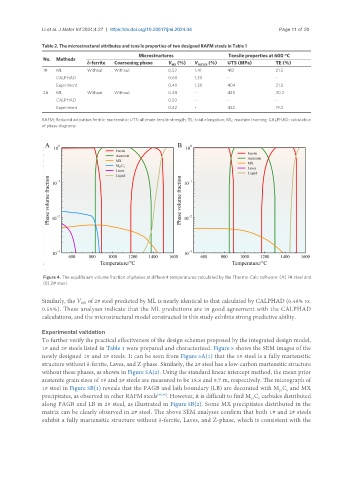
                Figure 4. The equilibrium volume fraction of phases at different temperatures calculated by the Thermo-Calc software: (A) 1# steel and
                (B) 2# steel.

               Similarly, the V  of 2# steel predicted by ML is nearly identical to that calculated by CALPHAD (0.48% vs.
                            MX
               0.50%). These analyses indicate that the ML predictions are in good agreement with the CALPHAD
               calculations, and the microstructural model constructed in this study exhibits strong predictive ability.

               Experimental validation
               To further verify the practical effectiveness of the design schemes proposed by the integrated design model,
               1# and 2# steels listed in Table 1 were prepared and characterized. Figure 5 shows the SEM images of the
               newly designed 1# and 2# steels. It can be seen from Figure 5A(1) that the 1# steel is a fully martensitic
               structure without δ-ferrite, Laves, and Z-phase. Similarly, the 2# steel has a low-carbon martensitic structure
               without these phases, as shown in Figure 5A(2). Using the standard linear intercept method, the mean prior
               austenite grain sizes of 1# and 2# steels are measured to be 18.8 and 9.7 m, respectively. The micrograph of
               1# steel in Figure 5B(1) reveals that the PAGB and lath boundary (LB) are decorated with M C  and MX
                                                                                                  6
                                                                                               23
               precipitates, as observed in other RAFM steels [45,46] . However, it is difficult to find M C  carbides distributed
                                                                                      23 6
               along PAGB and LB in 2# steel, as illustrated in Figure 5B(2). Some MX precipitates distributed in the
               matrix can be clearly observed in 2# steel. The above SEM analyses confirm that both 1# and 2# steels
               exhibit a fully martensitic structure without δ-ferrite, Laves, and Z-phase, which is consistent with the

