


Page 13 - Read Online
P. 13
Li et al. J Mater Inf 2024;4:27  https://dx.doi.org/10.20517/jmi.2024.44                                                                                                      Page 7 of 20


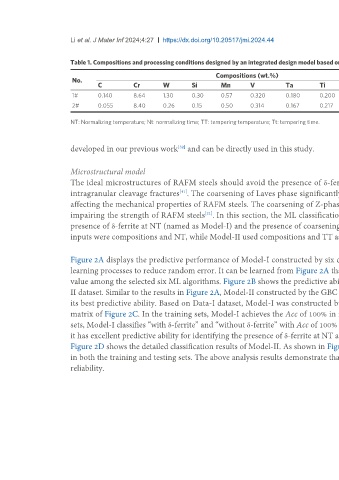
                          Table 1. Compositions and processing conditions designed by an integrated design model based on specific requirements

                                                                             Compositions (wt.%)                                                                      Processing parameters
                          No.
                                   C            Cr        W         Si         Mn        V           Ta          Ti           N              NT (°C)           Nt (min)            TT (°C)          Tt (min)
                          1#       0.140        8.64      1.30      0.30       0.57      0.320       0.180       0.200        0.0003         1120              21                  720              62

                          2#       0.055        8.40      0.26      0.15       0.50      0.314       0.167       0.217        0.0030         1020              30                  650              50

                          NT: Normalizing temperature; Nt: normalizing time; TT: tempering temperature; Tt: tempering time.


                                                                [32]
                          developed in our previous work  and can be directly used in this study.

                          Microstructural model

                          The ideal microstructures of RAFM steels should avoid the presence of δ-ferrite, Laves, and Z-phase. δ-ferrite is regarded as an easy propagation site for
                          intragranular cleavage fractures . The coarsening of Laves phase significantly weakens microstructural stability and accelerates void growth                               [42,43] , adversely
                                                                [41]
                          affecting the mechanical properties of RAFM steels. The coarsening of Z-phase consumes fine MX-type precipitates during long-term testing and servicing,
                          impairing the strength of RAFM steels . In this section, the ML classification algorithms were applied to construct prediction models for identifying the
                                                                         [21]
                          presence of δ-ferrite at NT (named as Model-I) and the presence of coarsening phases (i.e., Laves and Z-phase) at TT (named as Model-II). For Model-I, the

                          inputs were compositions and NT, while Model-II used compositions and TT as inputs.


                          Figure 2A displays the predictive performance of Model-I constructed by six common ML classification algorithms, with each data point averaged over 100
                          learning processes to reduce random error. It can be learned from Figure 2A that the Model-I model developed by the GBC algorithm achieves the highest Acc
                          value among the selected six ML algorithms. Figure 2B shows the predictive ability of Model-II constructed by six ML classification algorithms based on Data-

                          II dataset. Similar to the results in Figure 2A, Model-II constructed by the GBC algorithm has the highest Acc among the selected six ML algorithms, indicating
                          its best predictive ability. Based on Data-I dataset, Model-I was constructed by GBC algorithm and its detailed classification results are shown in confusion

                          matrix of Figure 2C. In the training sets, Model-I achieves the Acc of 100% in identifying both “with δ-ferrite” and “without δ-ferrite” classes. For the testing
                          sets, Model-I classifies “with δ-ferrite” and “without δ-ferrite” with Acc of 100% and 98.0%, respectively. Model-I exhibits high accuracy (> 90%), indicating that
                          it has excellent predictive ability for identifying the presence of δ-ferrite at NT and neither obvious overfitting nor under-fitting issues. The confusion matrix in

                          Figure 2D shows the detailed classification results of Model-II. As shown in Figure 2D, Model-II constructed by the GBC algorithm achieves the Acc of > 85.0%
                          in both the training and testing sets. The above analysis results demonstrate that the Model-I and Model-II constructed in this work have good robustness and

                          reliability.

