


Page 79 - Read Online
P. 79
Monaco et al. J Environ Expo Assess 2024;3:18  https://dx.doi.org/10.20517/jeea.2024.10  Page 11 of 18

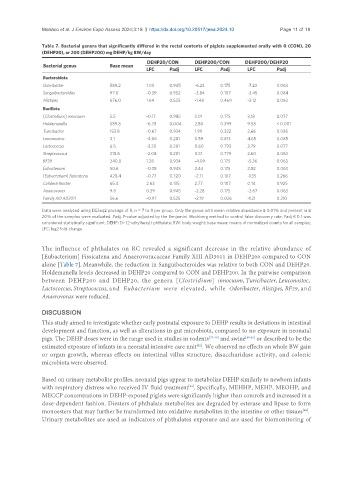
               Table 7. Bacterial genera that significantly differed in the rectal contents of piglets supplemented orally with 0 (CON), 20
               (DEHP20), or 200 (DEHP200) mg DEHP/kg BW/day
                                                   DEHP20/CON      DEHP200/CON      DEHP200/DEHP20
                Bacterial genus       Base mean
                                                  LFC     Padj     LFC     Padj     LFC       Padj
                Bacteroidota
                Odoribacter           589.2       1.00    0.945    -6.23   0.175    -7.23     0.063
                Sanguibacteroides     97.0        -0.39   0.952    -3.84   0.107    -3.45     0.084
                Alistipes             676.0       1.64    0.525    -1.48   0.469    -3.12     0.063
                Bacillota
                [Clostridium] innocuum  5.5       -0.17   0.985    3.01    0.175    3.18      0.077
                Holdemanella          589.8       -6.78   0.004    2.80    0.399    9.58      < 0.001
                Turicibacter          153.8       -0.67   0.934    1.99    0.322    2.66      0.085
                Leuconostoc           3.1         -4.06   0.281    0.59    0.813    4.65      0.085
                Lactococcus           6.5         -3.20   0.281    0.60    0.792    3.79      0.077
                Streptococcus         218.6       -2.08   0.281    0.51    0.779    2.60      0.063
                RF39                  240.0       1.28    0.934    -4.09   0.175    -5.36     0.063
                Eubacterium           50.6        -0.38   0.945    2.44    0.175    2.82      0.063
                [Eubacterium] fissicatena  428.4  -0.77   0.720    -2.11   0.107    -1.35     0.266
                Colidextribacter      65.4        2.63    0.135    2.77    0.107    0.14      0.925
                Anaerovorax           9.8         0.39    0.945    -2.28   0.175    -2.67     0.063
                Family XIII AD3011    56.6        -0.97   0.525    -2.19   0.026    -1.21     0.210

               Data were analyzed using DESeq2 package of R, n = 7 to 8 per group. Only the genus with mean relative abundance ≥ 0.01% and present in ≥
               20% of the samples were evaluated. Padj, P-value adjusted by the Benjamini–Hochberg method to control false discovery rate; Padj ≤ 0.1 was
               considered statistically significant. DEHP: Di-(2-ethylhexyl) phthalate; BW: body weight; base mean: means of normalized counts for all samples;
               LFC: log2 fold-change.


               The influence of phthalates on RC revealed a significant decrease in the relative abundance of
               [Eubacterium] Fissicatena and Anaerovoracaceae Family XIII AD3011 in DEHP200 compared to CON
               alone [Table 7]. Meanwhile, the reduction in Sanguibacteroides was relative to both CON and DEHP20.
               Holdemanella levels decreased in DEHP20 compared to CON and DEHP200. In the pairwise comparison
               between  DEHP200  and  DEHP20,  the  genera  [Clostridium]  innocuum, Turicibacter, Leuconostoc,
               Lactococcus, Streptococcus, and  Eubacterium  were  elevated,  while  Odoribacter, Alistipes, RF29, and
               Anaerovorax were reduced.

               DISCUSSION
               This study aimed to investigate whether early postnatal exposure to DEHP results in deviations in intestinal
               development and function, as well as alterations in gut microbiota, compared to no exposure in neonatal
               pigs. The DEHP doses were in the range used in studies in rodents [37-39]  and swine [40,41]  or described to be the
               estimated exposure of infants in a neonatal intensive care unit . We observed no effects on whole BW gain
                                                                   [42]
               or organ growth, whereas effects on intestinal villus structure, disaccharidase activity, and colonic
               microbiota were observed.

               Based on urinary metabolite profiles, neonatal pigs appear to metabolize DEHP similarly to newborn infants
               with respiratory distress who received IV fluid treatment . Specifically, MEHHP, MEHP, MEOHP, and
                                                                 [43]
               MECCP concentrations in DEHP-exposed piglets were significantly higher than controls and increased in a
               dose-dependent fashion. Diesters of phthalate metabolites are degraded by esterase and lipase to form
                                                                                                       [44]
               monoesters that may further be transformed into oxidative metabolites in the intestine or other tissues .
               Urinary metabolites are used as indicators of phthalates exposure and are used for biomonitoring of

