


Page 77 - Read Online
P. 77
Monaco et al. J Environ Expo Assess 2024;3:18  https://dx.doi.org/10.20517/jeea.2024.10  Page 9 of 18

               Table 4. Alpha diversity measures of ascending colon and rectal contents of piglets supplemented orally with 0 (CON), 20
               (DEHP20), or 200 (DEHP200) mg DEHP/kg BW/day
                                                            Treatment groups
                                          CON              DEHP20           DEHP200          P-value
                Ascending colon
                                                a                b                b
                Observed features         365 ± 24.8       451 ± 21.8       448 ± 18.2       0.012
                Evenness                  0.7 ± 0.01       0.73 ± 0.01      0.74 ± 0.01      0.073
                Shannon index             5.9 ± 0.17 a     6.4 ± 0.09 b     6.5 ± 0.14 b     0.0117
                Faith’s PD                16.3 ± 0.55      17.6 ± 0.58      17.1 ± 0.4       0.19
                Rectum
                Observed features         392 ± 18.5       421 ± 23         462 ± 22.9       0.069
                Evenness                  0.74 ± 0.02      0.74 ± 0.01      0.73 ± 0.01      0.99
                Shannon index             6.4 ± 0.23       6.4 ± 0.14       6.5 ± 0.16       0.83
                Faith’s PD                17.9 ± 0.51      18.7 ± 0.75      18.5 ± 0.58      0.64

               Data are expressed as mean ± SEM. Different letters superscripts in a row indicate differences at P < 0.05. n = 7 to 8 per group. DEHP: Di-(2-
               ethylhexyl) phthalate; BW: body weight; PD: phylogenetic diversity; SEM: standard error of the means.


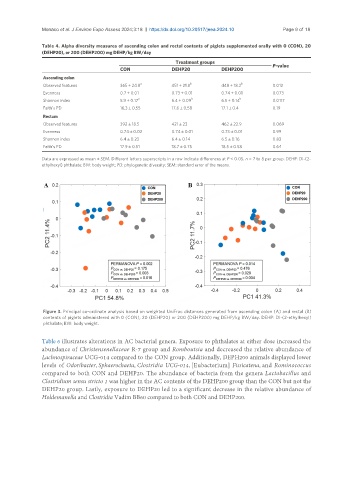
                Figure 3. Principal co-ordinate analysis based on weighted UniFrac distances generated from ascending colon (A) and rectal (B)
                contents of piglets administered with 0 (CON), 20 (DEHP20) or 200 (DEHP200) mg DEHP/kg BW/day. DEHP: Di-(2-ethylhexyl)
                phthalate; BW: body weight.

               Table 6 illustrates alterations in AC bacterial genera. Exposure to phthalates at either dose increased the
               abundance of Christensenellaceae R-7 group and Romboutsia and decreased the relative abundance of
               Lachnospiraceae UCG-014 compared to the CON group. Additionally, DEPH200 animals displayed lower
               levels of Odoribacter, Sphaerochaeta, Clostridia UCG-014, [Eubacterium] Fissicatena, and Rominococcus
               compared to both CON and DEHP20. The abundance of bacteria from the genera Lactobacillus and
               Clostridium sensu stricto 1 was higher in the AC contents of the DEHP200 group than the CON but not the
               DEHP20 group. Lastly, exposure to DEHP20 led to a significant decrease in the relative abundance of
               Holdemanella and Clostridia Vadim BB60 compared to both CON and DEHP200.

