


Page 76 - Read Online
P. 76
Page 8 of 18              Monaco et al. J Environ Expo Assess 2024;3:18  https://dx.doi.org/10.20517/jeea.2024.10

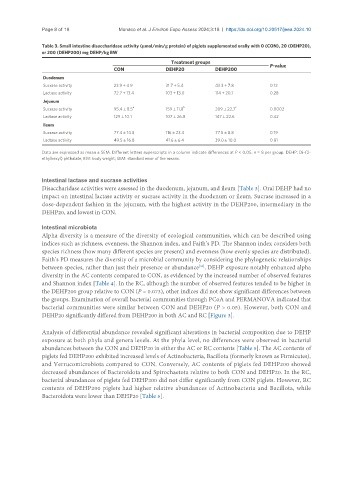
               Table 3. Small intestine disaccharidase activity (μmol/min/g protein) of piglets supplemented orally with 0 (CON), 20 (DEHP20),
               or 200 (DEHP200) mg DEHP/kg BW
                                                           Treatment groups
                                       CON               DEHP20           DEHP200           P-value
                Duodenum
                Sucrase activity       23.9 ± 4.9        31.7 ± 5.4       43.3 ± 7.8        0.12
                Lactase activity       72.7 ± 13.4       103 ± 13.0       114 ± 20.1        0.28
                Jejunum
                                              a                b                c
                Sucrase activity       95.4 ± 8.5        159 ± 11.8       209 ± 22.7        0.0002
                Lactase activity       129 ± 10.1        107 ± 26.8       147 ± 22.6        0.42
                Ileum
                Sucrase activity       77.4 ± 14.3       116 ± 23.4       77.5 ± 8.8        0.19
                Lactase activity       49.5 ± 16.8       41.6 ± 6.4       39.0 ± 10.0       0.81

               Data are expressed as mean ± SEM. Different letters superscripts in a column indicate differences at P < 0.05. n = 8 per group. DEHP: Di-(2-
               ethylhexyl) phthalate; BW: body weight; SEM: standard error of the means.


               Intestinal lactase and sucrase activities
               Disaccharidase activities were assessed in the duodenum, jejunum, and ileum [Table 3]. Oral DEHP had no
               impact on intestinal lactase activity or sucrase activity in the duodenum or ileum. Sucrase increased in a
               dose-dependent fashion in the jejunum, with the highest activity in the DEHP200, intermediary in the
               DEHP20, and lowest in CON.

               Intestinal microbiota
               Alpha diversity is a measure of the diversity of ecological communities, which can be described using
               indices such as richness, evenness, the Shannon index, and Faith’s PD. The Shannon index considers both
               species richness (how many different species are present) and evenness (how evenly species are distributed).
               Faith’s PD measures the diversity of a microbial community by considering the phylogenetic relationships
               between species, rather than just their presence or abundance . DEHP exposure notably enhanced alpha
                                                                    [36]
               diversity in the AC contents compared to CON, as evidenced by the increased number of observed features
               and Shannon index [Table 4]. In the RC, although the number of observed features tended to be higher in
               the DEHP200 group relative to CON (P = 0.073), other indices did not show significant differences between
               the groups. Examination of overall bacterial communities through PCoA and PERMANOVA indicated that
               bacterial communities were similar between CON and DEHP20 (P > 0.05). However, both CON and
               DEHP20 significantly differed from DEHP200 in both AC and RC [Figure 3].

               Analysis of differential abundance revealed significant alterations in bacterial composition due to DEHP
               exposure at both phyla and genera levels. At the phyla level, no differences were observed in bacterial
               abundances between the CON and DEHP20 in either the AC or RC contents [Table 5]. The AC contents of
               piglets fed DEHP200 exhibited increased levels of Actinobacteria, Bacillota (formerly known as Firmicutes),
               and Verrucomicrobiota compared to CON. Conversely, AC contents of piglets fed DEHP200 showed
               decreased abundances of Bacteroidota and Spirochaetota relative to both CON and DEHP20. In the RC,
               bacterial abundances of piglets fed DEHP200 did not differ significantly from CON piglets. However, RC
               contents of DEHP200 piglets had higher relative abundances of Actinobacteria and Bacillota, while
               Bacteroidota were lower than DEHP20 [Table 5].

