


Page 86 - Read Online
P. 86
Liu et al. Intell Robot 2024;4(3):256-75  I http://dx.doi.org/10.20517/ir.2024.17   Page 270


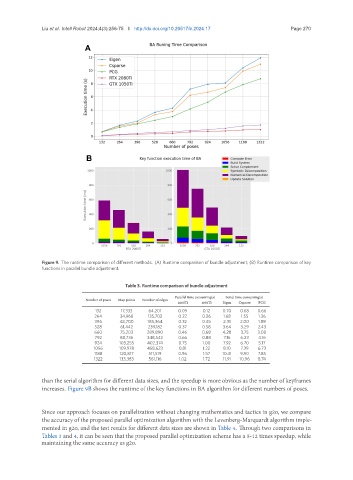
               Figure 9. The runtime comparison of different methods. (A) Runtime comparison of bundle adjustment; (B) Runtime comparison of key
               functions in parallel bundle adjustment.


                                           Table 3. Runtime comparison of bundle adjustment
                                                            Parallel time consuming(s)  Serial time consuming(s)
                              Number of poses  Map points  Number of edges
                                                             2080Ti  1050Ti  Eigen  Csparse  PCG
                                 132      17,333   64,201    0.09    0.12   0.70  0.68  0.66
                                 264     34,968    135,702   0.22    0.26   1.68  1.55  1.36
                                 396     48,700    185,364   0.32    0.45   2.31  2.00  1.88
                                 528      61,442   239,182   0.37    0.58   3.64  3.29  2.43
                                 660      75,203   289,890   0.46    0.68   4.28  3.75  3.00
                                 792      88,736   348,542   0.66    0.88   7.16  6.23  4.16
                                 924     103,255   402,374   0.75    1.00   7.92  6.70  5.17
                                 1056    109,978   458,623   0.81    1.22   8.10  7.39  6.73
                                 1188    120,817   511,519   0.96    1.57   10.41  9.90  7.85
                                 1322    133,383   561,116   1.02    1.72   11.91  10.96  8.74


               than the serial algorithm for different data sizes, and the speedup is more obvious as the number of keyframes
               increases. Figure 9B shows the runtime of the key functions in BA algorithm for different numbers of poses.


               Since our approach focuses on parallelization without changing mathematics and tactics in g2o, we compare
               the accuracy of the proposed parallel optimization algorithm with the Levenberg-Marquardt algorithm imple-
               mented in g2o, and the test results for different data sizes are shown in Table 4. Through two comparisons in
               Tables 3 and 4, it can be seen that the proposed parallel optimization scheme has a 5-12 times speedup, while
               maintaining the same accuracy as g2o.

