


Page 88 - Read Online
P. 88
Liu et al. Intell Robot 2024;4(3):256-75  I http://dx.doi.org/10.20517/ir.2024.17   Page 272

                                      Table 6. Tracking accuracy comparison of different VSLAM systems
                                                              ORB   Open   CUDA-
                                                  Evaluation index
                                                             SLAM2  VSLAM  SLAM
                                                     Max     0.027  0.057  0.036
                                                    Mean     0.008  0.008  0.012
                                          RPE (m)   Median   0.006  0.004  0.010
                                                     Rmse    0.010  0.013  0.014
                                                     Std     0.006  0.009  0.007
                                                     Max      0.991  2.344  1.474
                                                    Mean     0.395  0.511  0.645
                                          APE (m)   Median   0.361  0.402  0.014
                                                     Rmse    0.448  0.684  0.720
                                                     Std     0.213  0.455  0.320
                                           VSLAM: Visual simultaneous localization and mapping;
                                           RPE: relative pose error; APE: absolute pose error; SLAM:
                                           simultaneous localization and mapping.

                                    Table 7. Runtime comparison of key modules in different VSLAM systems

                                                    ORB-SLAM2  OpenVSLAM  CUDA-SLAM
                                           Front-end  48 ms    52 ms     12 ms
                                            Back-end  138 ms   144 ms    41 ms
                                            VSLAM: Visual simultaneous localization and mapping;
                                            CUDA: compute unified device architecture; SLAM: si-
                                            multaneous localization and mapping.


               4.3 Heterogeneous VSLAM system
               It is shown that the parallel feature extraction and matching algorithm in Section III-A and the BA algorithm
               in Section III-B based on CUDA have a significant improvement in running efficiency with approximately
               the same accuracy as the serial algorithm. Therefore, we integrate the above-mentioned modules with our
               proposed accelerated nodes to realize the real-time performance of the common VSLAM system, and the
               detailed thread parameters are shown in Table 5. The improved is called CUDA-SLAM and is compared with
               the popular SLAM methods including ORB-SLAM [17,18]  and OpenVSLAM [31] . The data used to evaluate the
               errors is from KITTI sequence 10, and the absolute pose error (APE) and relative pose error (RPE) are used
               to evaluate the accuracy of VSLAM methods. The main parameters are used as follows: the number of feature
               points is set to 2000, and the covisible keyframe threshold is set to 15; that is, an edge between two keyframes
               exists if they share observations of the same map points (at least 15).


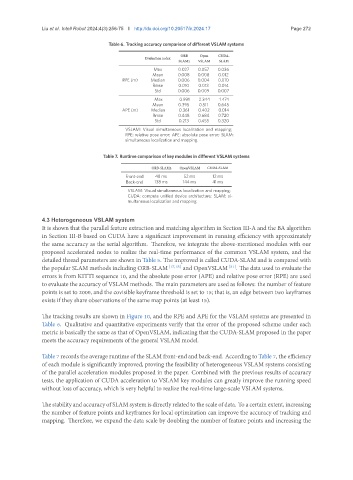
               The tracking results are shown in Figure 10, and the RPE and APE for the VSLAM systems are presented in
               Table 6. Qualitative and quantitative experiments verify that the error of the proposed scheme under each
               metric is basically the same as that of OpenVSLAM, indicating that the CUDA-SLAM proposed in the paper
               meets the accuracy requirements of the general VSLAM model.

               Table 7 records the average runtime of the SLAM front-end and back-end. According to Table 7, the efficiency
               of each module is significantly improved, proving the feasibility of heterogeneous VSLAM systems consisting
               of the parallel acceleration modules proposed in the paper. Combined with the previous results of accuracy
               tests, the application of CUDA acceleration to VSLAM key modules can greatly improve the running speed
               without loss of accuracy, which is very helpful to realize the real-time large-scale VSLAM systems.

               ThestabilityandaccuracyofSLAMsystemis directlyrelated tothescale ofdata. Toacertain extent, increasing
               the number of feature points and keyframes for local optimization can improve the accuracy of tracking and
               mapping. Therefore, we expand the data scale by doubling the number of feature points and increasing the

