


Page 41 - Read Online
P. 41
Page 16 of 23  Shanmugasundaram et al. Energy Mater. 2025, 5, 500100  https://dx.doi.org/10.20517/energymater.2024.304


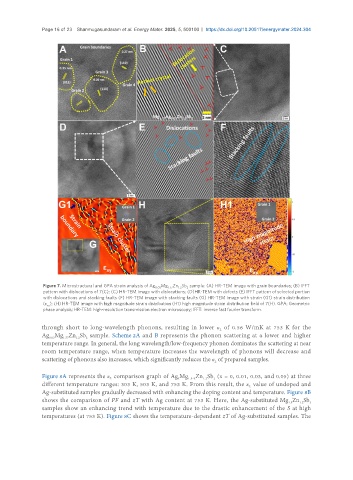
                Figure 7. Microstructural and GPA strain analysis of Ag  Mg  Zn Sb  sample: (A) HR-TEM image with grain boundaries; (B) IFFT
                                                     0.03  1.77  1.2  2
                pattern with dislocations of 7(C); (C) HR-TEM image with dislocations; (D)HR-TEM with defects (E) IFFT pattern of selected portion
                with dislocations and stacking faults (F) HR-TEM image with stacking faults (G) HR-TEM image with strain (G1) strain distribution
                (ε ); (H) HR-TEM image with high magnitude strain distribution (H1) high magnitude strain distribution field of 7(H). GPA: Geometric
                 xy
                phase analysis; HR-TEM: high-resolution transmission electron microscopy; IFFT: inverse fast fourier transform.
               through short to long-wavelength phonons, resulting in lower  κ  of 0.56 W/mK at 753 K for the
                                                                           L
               Ag Mg Zn Sb  sample. Scheme 2A and B represents the phonon scattering at a lower and higher
                  0.03
                      1.77
                              2
                           1.2
               temperature range. In general, the long wavelength/low-frequency phonon dominates the scattering at near
               room temperature range, when temperature increases the wavelength of phonons will decrease and
               scattering of phonons also increases, which significantly reduces the κ  of prepared samples.
                                                                         L
               Figure 8A represents the κ  comparison graph of Ag Mg Zn Sb  (x = 0, 0.01, 0.03, and 0.05) at three
                                                                1.8-x
                                                             x
                                                                         2
                                                                     1.2
                                      L
               different temperature ranges: 303 K, 503 K, and 753 K. From this result, the κ  value of undoped and
                                                                                     L
               Ag-substituted samples gradually decreased with enhancing the doping content and temperature. Figure 8B
               shows the comparison of PF and zT with Ag content at 753 K. Here, the Ag-substituted Mg Zn Sb
                                                                                                  1.8
                                                                                                      1.2
                                                                                                         2
               samples show an enhancing trend with temperature due to the drastic enhancement of the S at high
               temperatures (at 753 K). Figure 8C shows the temperature-dependent zT of Ag-substituted samples. The

