


Page 39 - Read Online
P. 39
Page 14 of 23  Shanmugasundaram et al. Energy Mater. 2025, 5, 500100  https://dx.doi.org/10.20517/energymater.2024.304


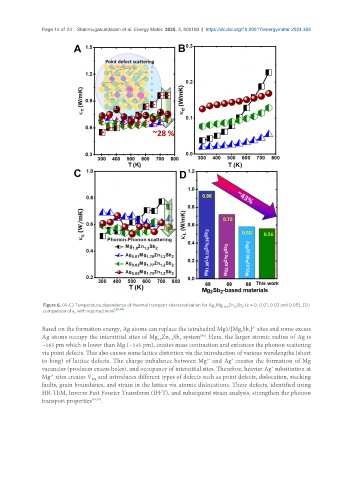
                Figure 6. (A-C) Temperature dependence of thermal transport characterization for Ag Mg 1.8-x Zn Sb  (x = 0, 0.01, 0.03 and 0.05), (D)
                                                                         x
                                                                                   2
                                                                                1.2
                comparison of κ  with reported work [68,69] .
                          L
               Based on the formation energy, Ag atoms can replace the tetrahedral Mg2/[Mg Sb ]  sites and some excess
                                                                                      2-
                                                                                  2
                                                                                     2
               Ag atoms occupy the interstitial sites of Mg Zn Sb  system . Here, the larger atomic radius of Ag is
                                                                     [45]
                                                      1.8
                                                          1.2
                                                              2
               ~165 pm which is lower than Mg (~145 pm), creates mass contraction and enhances the phonon scattering
               via point defects. This also causes some lattice distortion via the introduction of various wavelengths (short
                                                                       2+
                                                                               +
               to long) of lattice defects. The charge imbalance between Mg  and Ag  creates the formation of Mg
               vacancies (produces excess holes), and occupancy of interstitial sites. Therefore, heavier Ag  substitution at
                                                                                             +
               Mg  sites creates V  and introduces different types of defects such as point defects, dislocation, stacking
                  2+
                                Mg
               faults, grain boundaries, and strain in the lattice via atomic dislocations. These defects, identified using
               HR-TEM, Inverse Fast Fourier Transform (IFFT), and subsequent strain analysis, strengthen the phonon
               transport properties [45,67] .

