


Page 34 - Read Online
P. 34
Shanmugasundaram et al. Energy Mater. 2025, 5, 500100  https://dx.doi.org/10.20517/energymater.2024.304  Page 9 of 23


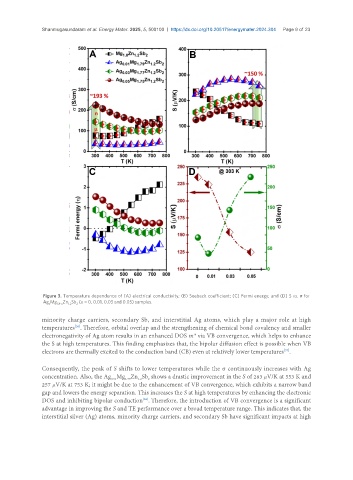
                Figure 3. Temperature dependence of (A) electrical conductivity; (B) Seebeck coefficient; (C) Fermi energy; and (D) S vs. σ for
                Ag Mg 1.8-x Zn Sb  (x = 0, 0.01, 0.03 and 0.05) samples.
                        1.2
                 x
                           2
               minority charge carriers, secondary Sb, and interstitial Ag atoms, which play a major role at high
                          [56]
               temperatures . Therefore, orbital overlap and the strengthening of chemical bond covalency and smaller
               electronegativity of Ag atom results in an enhanced DOS m* via VB convergence, which helps to enhance
               the S at high temperatures. This finding emphasizes that, the bipolar diffusion effect is possible when VB
               electrons are thermally excited to the conduction band (CB) even at relatively lower temperatures .
                                                                                                 [57]

               Consequently, the peak of S shifts to lower temperatures while the σ continuously increases with Ag
               concentration. Also, the Ag Mg Zn Sb  shows a drastic improvement in the S of 283 µV/K at 553 K and
                                               1.2
                                           1.79
                                      0.01
                                                   2
               257 µV/K at 753 K; it might be due to the enhancement of VB convergence, which exhibits a narrow band
               gap and lowers the energy separation. This increases the S at high temperatures by enhancing the electronic
                                                 [58]
               DOS and inhibiting bipolar conduction . Therefore, the introduction of VB convergence is a significant
               advantage in improving the S and TE performance over a broad temperature range. This indicates that, the
               interstitial silver (Ag) atoms, minority charge carriers, and secondary Sb have significant impacts at high

