


Page 32 - Read Online
P. 32
Shanmugasundaram et al. Energy Mater. 2025, 5, 500100 https://dx.doi.org/10.20517/energymater.2024.304 Page 7 of 23
Carrier transport properties of Ag Mg Zn Sb
x 1.8-x 1.2 2
Figure 2A represents the schematic representation of the band diagram for undoped Mg Sb , Mg Zn Sb ,
1.8
2
1.2
3
2
and Ag-doped Mg Zn Sb systems, which confirms the role of the heavy element Ag in the lighter Mg site
1.8
2
1.2
led to E towards the VB and enhanced hole concentration, which reduces the band gap. Figure 2B indicates
F
the VB convergence before and after heavy element substitution in the Mg Zn Sb matrix. This scheme
2
1.8
1.2
represents that, Ag substitution leads to narrowed band gap and enhance the valley degeneracy, respectively.
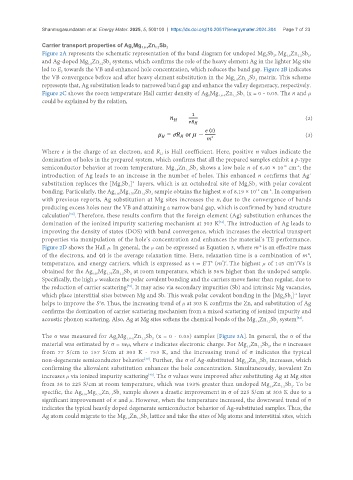
Figure 2C shows the room temperature Hall carrier density of Ag Mg Zn Sb (x = 0 - 0.05. The n and μ
2
x
1.8-x
1.2
could be explained by the relation,
(2)
(3)
Where e is the charge of an electron, and R is Hall coefficient. Here, positive n values indicate the
H
domination of holes in the prepared system, which confirms that all the prepared samples exhibit a p-type
semiconductor behavior at room temperature. Mg Zn Sb shows a low hole n of 6.40 × 10 cm ; the
18
-3
2
1.2
1.8
introduction of Ag leads to an increase in the number of holes. This enhanced n confirms that Ag +
substitution replaces the [Mg Sb ] layers, which is an octahedral site of Mg Sb with polar covalent
2-
2
2
2
3
-3
19
bonding. Particularly, the Ag Mg Zn Sb sample obtains the highest n of 8.19 × 10 cm . In comparison
0.05
1.75
2
1.2
with previous reports, Ag substitution at Mg sites increases the n, due to the convergence of bands
producing excess holes near the VB and attaining a narrow band gap, which is confirmed by band structure
[50]
calculation . Therefore, these results confirm that the foreign element (Ag) substitution enhances the
domination of the ionized impurity scattering mechanism at 303 K . The introduction of Ag leads to
[51]
improving the density of states (DOS) with band convergence, which increases the electrical transport
properties via manipulation of the hole’s concentration and enhances the material’s TE performance.
Figure 2D shows the Hall μ. In general, the μ can be expressed as Equation 3, where m* is an effective mass
of the electrons, and is the average relaxation time. Here, relaxation time is a combination of m*,
r s
2
* t
temperature, and energy carriers, which is expressed as τ µ E T (m ). The highest μ of 145 cm /Vs is
obtained for the Ag Mg Zn Sb at room temperature, which is 56% higher than the undoped sample.
2
1.2
1.75
0.05
Specifically, the high μ weakens the polar covalent bonding and the carriers move faster than regular, due to
the reduction of carrier scattering . It may arise via secondary impurities (Sb) and intrinsic Mg vacancies,
[52]
which place interstitial sites between Mg and Sb. This weak polar covalent bonding in the [Mg Sb ] layer
-2
2
2
helps to improve the S σ. Thus, the increasing trend of μ at 303 K confirms the Zn, and substitution of Ag
2
confirms the domination of carrier scattering mechanism from a mixed scattering of ionized impurity and
[34]
acoustic phonon scattering. Also, Ag at Mg sites softens the chemical bonds of the Mg Zn Sb system .
1.2
1.8
2
The σ was measured for Ag Mg 1.8-x Zn Sb (x = 0 - 0.05) samples [Figure 3A]. In general, the σ of the
1.2
x
2
material was estimated by σ = neμ, where e indicates electronic charge. For Mg Zn Sb , the σ increases
2
1.2
1.8
from 77 S/cm to 157 S/cm at 303 K - 753 K, and the increasing trend of σ indicates the typical
non-degenerate semiconductor behavior . Further, the σ of Ag-substituted Mg Zn Sb increases, which
[30]
2
1.8
1.2
confirming the aliovalent substitution enhances the hole concentration. Simultaneously, isovalent Zn
increases μ via ionized impurity scattering . The σ values were improved after substituting Ag at Mg sites
[40]
from 38 to 225 S/cm at room temperature, which was 193% greater than undoped Mg Zn Sb . To be
1.2
1.8
2
specific, the Ag Mg Zn Sb sample shows a drastic improvement in σ of 225 S/cm at 303 K due to a
1.75
0.05
2
1.2
significant improvement of n and μ. However, when the temperature increased, the downward trend of σ
indicates the typical heavily doped degenerate semiconductor behavior of Ag-substituted samples. Thus, the
Ag atom could migrate to the Mg Zn Sb lattice and take the sites of Mg atoms and interstitial sites, which
1.8
1.2
2

