


Page 33 - Read Online
P. 33
Page 8 of 23  Shanmugasundaram et al. Energy Mater. 2025, 5, 500100  https://dx.doi.org/10.20517/energymater.2024.304


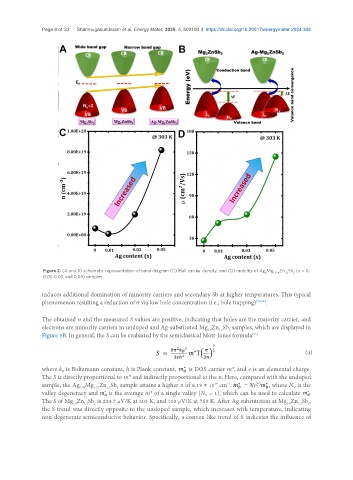
                Figure 2. (A and B) schematic representation of band diagram (C) Hall carrier density, and (D) mobility of Ag Mg  Zn Sb  (x = 0,
                                                                                          x  1.8-x  1.2  2
                0.01, 0.03, and 0.05) samples.

               induces additional domination of minority carriers and secondary Sb at higher temperatures. This typical
               phenomenon resulting a reduction of σ via low hole concentration (i.e., hole trapping) [53,54] .

               The obtained n and the measured S values are positive, indicating that holes are the majority carrier, and
               electrons are minority carriers in undoped and Ag-substituted Mg Zn Sb  samples, which are displayed in
                                                                              2
                                                                       1.8
                                                                           1.2
               Figure 3B. In general, the S can be evaluated by the semiclassical Mott-Jones formula [55]
                                                                                                        (4)


               where k  is Boltzmann constant, h is Plank constant,       is DOS carrier m*, and e is an elemental charge.
                      B
               The S is directly proportional to m* and indirectly proportional to the n. Here, compared with the undoped
                                                                         19
               sample, the Ag Mg Zn Sb  sample attains a higher n of 8.19 × 10  cm .                       , where N  is the
                                                                              -3
                                        2
                                                                                                    V
                                     1.2
                                 1.75
                            0.05
               valley degeneracy and      is the average m* of a single valley (N  = 1), which can be used to calculate     .
                                                                      V
               The S of Mg Zn Sb  is 234.7 µV/K at 303 K, and 103 µV/K at 753 K. After Ag substitution at Mg Zn Sb ,
                                                                                                  1.8
                                                                                                     1.2
                             1.2
                                 2
                          1.8
                                                                                                         2
               the S trend was directly opposite to the undoped sample, which increases with temperature, indicating
               non-degenerate semiconductor behavior. Specifically, a convex-like trend of S indicates the influence of

