


Page 38 - Read Online
P. 38
Shanmugasundaram et al. Energy Mater. 2025, 5, 500100  https://dx.doi.org/10.20517/energymater.2024.304  Page 13 of 23


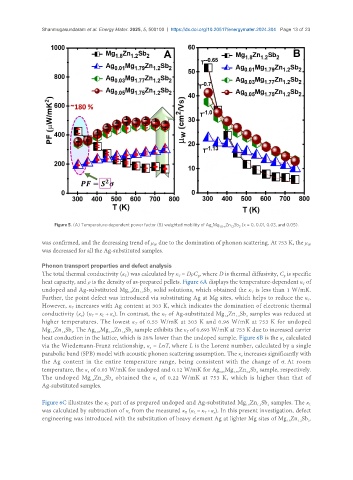
                   Figure 5. (A) Temperature-dependent power factor (B) weighted mobility of Ag Mg 1.8-x Zn Sb  (x = 0, 0.01, 0.03, and 0.05).
                                                                                  2
                                                                               1.2
                                                                        x
               was confirmed, and the decreasing trend of μ  due to the domination of phonon scattering. At 753 K, the μ W
                                                     W
               was decreased for all the Ag-substituted samples.

               Phonon transport properties and defect analysis
               The total thermal conductivity (κ ) was calculated by κ  = DρC , where D is thermal diffusivity, C  is specific
                                           T
                                                                                                 p
                                                                    p
                                                             T
               heat capacity, and ρ is the density of as-prepared pellets. Figure 6A displays the temperature-dependent κ  of
                                                                                                       T
               undoped and Ag-substituted Mg Zn Sb  solid solutions, which obtained the κ  is less than 1 W/mK.
                                                1.2
                                            1.8
                                                    2
                                                                                      T
               Further, the point defect was introduced via substituting Ag at Mg sites, which helps to reduce the κ .
                                                                                                         T
               However, κ  increases with Ag content at 303 K, which indicates the domination of electronic thermal
                         T
               conductivity (κ ) (κ  = κ  + κ ). In contrast, the κ  of Ag-substituted Mg Zn Sb  samples was reduced at
                                                        T
                                T
                                   L
                                       e
                                                                                    2
                                                                                1.2
                            e
                                                                             1.8
               higher temperatures. The lowest  κ  of 0.55 W/mK at 303 K and 0.96 W/mK at 753 K for undoped
                                               T
               Mg Zn Sb . The Ag Mg Zn Sb  sample exhibits the κ  of 0.693 W/mK at 753 K due to increased carrier
                  1.8
                                             2
                      1.2
                                      1.77
                                 0.03
                         2
                                          1.2
                                                                T
               heat conduction in the lattice, which is 28% lower than the undoped sample. Figure 6B is the κ  calculated
                                                                                                e
               via the Wiedemann-Franz relationship, κ  = LσT, where L is the Lorenz number, calculated by a single
                                                    e
               parabolic band (SPB) model with acoustic phonon scattering assumption. The κ  increases significantly with
                                                                                  e
               the Ag content in the entire temperature range, being consistent with the change of  σ. At room
               temperature, the κ  of 0.03 W/mK for undoped and 0.12 W/mK for Ag Mg Zn Sb  sample, respectively.
                               e
                                                                           0.05
                                                                                1.75
                                                                                    1.2
                                                                                       2
               The undoped Mg Zn Sb  obtained the  κ  of 0.22 W/mK at 753 K, which is higher than that of
                                       2
                                                      e
                               1.8
                                   1.2
               Ag-substituted samples.
               Figure 6C illustrates the κ  part of as prepared undoped and Ag-substituted Mg Zn Sb  samples. The κ L
                                                                                    1.8
                                                                                           2
                                                                                        1.2
                                     L
               was calculated by subtraction of κ  from the measured κ  (κ  = κ  - κ ). In this present investigation, defect
                                                                  L
                                                               T
                                            e
                                                                         e
                                                                      T
               engineering was introduced with the substitution of heavy element Ag at lighter Mg sites of Mg Zn Sb .
                                                                                                         2
                                                                                                  1.8
                                                                                                     1.2

