


Page 37 - Read Online
P. 37
Page 12 of 23  Shanmugasundaram et al. Energy Mater. 2025, 5, 500100  https://dx.doi.org/10.20517/energymater.2024.304

               Figure 4E1 shows the Zn-d states, which strongly overlap with Sb-s and Mg-s from -0.2 eV to -1.3 eV of the
               VB region, implying that Zn-Sb and Zn-Mg bonding structures of Mg ZnSb . It is also observed that, the
                                                                                 2
                                                                            2
               Ag-d orbitals hybridize with the Sb-p and Mg-p near the Fermi and VB regions from -0.21 eV to -0.95 eV,
               illustrating the Ag-Sb and Ag-Mg bonding states of Ag at Mg ZnSb . Furthermore, the Sb-s and Mg-p
                                                                      2
                                                                           2
               orbitals hybridize with the Zn-d orbitals from the VB region from ~ -0.51 eV to -1.25 eV indicating the
               formation of a covalent bond between Zn, Sb, and Mg. Figure 4F1 shows the bottom of the near Fermi
               region, which is contributed by the intermixing of p-d orbitals of Ag-Sb hybridized bands. This difference in
               the electronic DOS pattern is responsible for the enhanced m* due to the incorporation of Ag in the
               Mg ZnSb  structure.
                  2
                       2
               Figure 5A represents the PF of undoped and Ag-doped Mg Zn Sb  samples, which is calculated by
                                                                        1.2
                                                                            2
                                                                     1.8
               PF = S σ. Regardless of the temperature, compared with Mg Zn Sb , Ag-substituted samples show the
                     2
                                                                    1.8
                                                                        1.2
                                                                           2
               increasing trend of PF due to the combination of large S and σ, respectively. When increasing the
                                                                                             2
                                                                                                         2
                                                                                 2
               concentration of Ag (x = 0, 0.01, 0.03, and 0.05), the PF value of 167 µW/mK , 299 µW/mK , 456 µW/mK ,
               and 467 µW/mK  was maximized at 753 K. Specifically, the highest PF observed for Ag Mg Zn Sb  of
                              2
                                                                                               1.75
                                                                                          0.05
                                                                                                    1.2
                                                                                                       2
               467 µW/mK  at 753 K, which is ~180% larger than the Mg Zn Sb  (167 µW/mK ). This result confirms that
                          2
                                                                                   2
                                                                   1.2
                                                                       2
                                                                1.8
               Ag-substitution at Mg sites of Mg Zn Sb  yields the best control over σ and S to optimize the improved PF
                                            1.8
                                               1.2
                                                   2
               at higher temperatures.
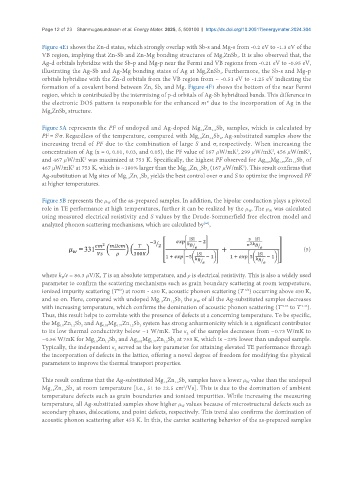
               Figure 5B represents the μ  of the as-prepared samples. In addition, the bipolar conduction plays a pivoted
                                     W
               role in TE performance at high temperatures, further it can be realized by the μ . The μ  was calculated
                                                                                            W
                                                                                     W
               using measured electrical resistivity and S values by the Drude-Sommerfield free electron model and
               analyzed phonon scattering mechanisms, which are calculated by ,
                                                                      [66]
                                                                                                       (5)
               where k /e = 86.3 µV/K, T is an absolute temperature, and ρ is electrical resistivity. This is also a widely used
                      B
               parameter to confirm the scattering mechanisms such as grain boundary scattering at room temperature,
               ionized impurity scattering (T ) at room - 450 K, acoustic phonon scattering (T ) occurring above 450 K,
                                                                                   -3/2
                                         3/2
               and so on. Here, compared with undoped Mg Zn Sb  the μ  of all the Ag-substituted samples decreases
                                                       1.8
                                                                   W
                                                          1.2
                                                              2
                                                                                                -0.65
               with increasing temperature, which confirms the domination of acoustic phonon scattering (T  to T ).
                                                                                                      -1.13
               Thus, this result helps to correlate with the presence of defects at a concerning temperature. To be specific,
               the Mg Zn Sb  and Ag Mg Zn Sb  system has strong anharmonicity which is a significant contributor
                                             1.2
                            2
                                    0.03
                                                2
                                        1.77
                     1.8
                         1.2
               to its low thermal conductivity below ~1 W/mK. The κ  of the samples decreases from ~0.73 W/mK to
                                                                L
               ~0.56 W/mK for Mg Zn Sb  and Ag Mg Zn Sb  at 753 K, which is ~23% lower than undoped sample.
                                 1.8
                                    1.2
                                        2
                                                        1.2
                                                            2
                                                    1.77
                                               0.03
               Typically, the independent κ  served as the key parameter for attaining elevated TE performance through
                                        L
               the incorporation of defects in the lattice, offering a novel degree of freedom for modifying the physical
               parameters to improve the thermal transport properties.
               This result confirms that the Ag-substituted Mg Zn Sb  samples have a lower μ  value than the undoped
                                                                                    W
                                                            1.2
                                                               2
                                                        1.8
               Mg Zn Sb  at room temperature [i.e., 51 to 22.5 cm /Vs]. This is due to the domination of ambient
                                                               2
                      1.2
                  1.8
                         2
               temperature defects such as grain boundaries and ionized impurities. While increasing the measuring
               temperature, all Ag-substituted samples show higher μ  values because of microstructural defects such as
                                                              W
               secondary phases, dislocations, and point defects, respectively. This trend also confirms the domination of
               acoustic phonon scattering after 453 K. In this, the carrier scattering behavior of the as-prepared samples

