


Page 43 - Read Online
P. 43
Page 18 of 23  Shanmugasundaram et al. Energy Mater. 2025, 5, 500100  https://dx.doi.org/10.20517/energymater.2024.304


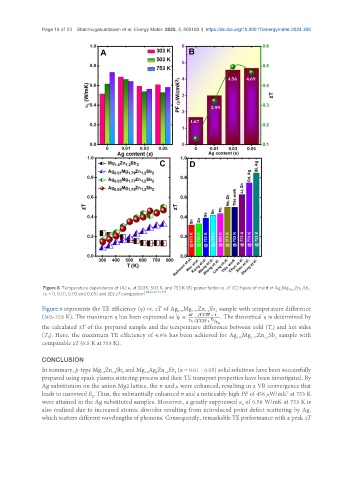
                Figure 8. Temperature dependence of (A) κ  at 303K, 503 K, and 753 K (B) power factor vs. zT (C) figure of merit of Ag Mg 1.8-x Zn Sb  2
                                             L
                                                                                                x
                                                                                                      1.2
                (x = 0, 0.01, 0.03 and 0.05) and (D) zT comparison [28,36,37,74-77] .
               Figure 9 represents the TE efficiency (η) vs. zT of Ag Mg Zn Sb  sample with temperature difference
                                                                          2
                                                             0.03
                                                                  1.77
                                                                      1.2
               (303-753 K). The maximum η has been expressed as                          . The theoretical η is determined by
               the calculated zT of the prepared sample and the temperature difference between cold (T ) and hot sides
                                                                                             c
               (T ). Here, the maximum TE efficiency of 4.9% has been achieved for Ag Mg Zn Sb  sample with
                                                                                 0.03
                                                                                              2
                                                                                      1.77
                                                                                          1.2
                 h
               comparable zT (0.5 K at 753 K).
               CONCLUSION
               In summary, p-type Mg Zn Sb  and Mg Ag Zn Sb  (x = 0.01 - 0.05) solid solutions have been successfully
                                                            2
                                                         1.2
                                       1.2
                                   1.8
                                          2
                                                      x
                                                  1.8
               prepared using spark plasma sintering process and their TE transport properties have been investigated. By
               Ag substitution on the anion Mg2 lattice, the n and μ were enhanced, resulting in a VB convergence that
               leads to narrowed E . Thus, the substantially enhanced σ and a noticeably high PF of 456 μW/mK  at 753 K
                                                                                                  2
                                g
               were attained in the Ag substituted samples. Moreover, a greatly suppressed κ  of 0.56 W/mK at 753 K is
                                                                                   L
               also realized due to increased atomic disorder resulting from introduced point defect scattering by Ag,
               which scatters different wavelengths of phonons. Consequently, remarkable TE performance with a peak zT

