


Page 27 - Read Online
P. 27
Page 2 of 23  Shanmugasundaram et al. Energy Mater. 2025, 5, 500100  https://dx.doi.org/10.20517/energymater.2024.304

               convergence and that defect engineering leads to simultaneous improvement in thermoelectric transport
               properties of p-type Mg Zn Sb .
                                     1.2
                                  1.8
                                        2
               Keywords: Mg Zn Sb , defect engineering, solid solution, band convergence, thermal conductivity
                                 2
                           1.8
                              1.2
               INTRODUCTION
               Thermoelectric (TE) materials have been significantly developed for heating and cooling applications. In
               this, the thermal energy is directly converted into electrical energy and vice versa by TE devices .
                                                                                                       [1,2]
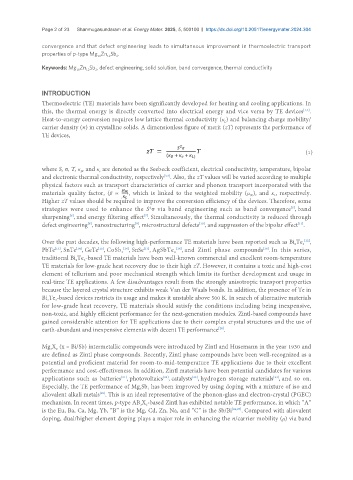
               Heat-to-energy conversion requires low lattice thermal conductivity (κ ) and balancing charge mobility/
                                                                             L
               carrier density (n) in crystalline solids. A dimensionless figure of merit (zT) represents the performance of
               TE devices,

                                                                                                        (1)


               where S, σ, T, κ , and κ  are denoted as the Seebeck coefficient, electrical conductivity, temperature, bipolar
                                   e
                            B
               and electronic thermal conductivity, respectively . Also, the zT values will be varied according to multiple
                                                        [3,4]
               physical factors such as transport characteristics of carrier and phonon transport incorporated with the
               materials  quality  factor,  (β  µ   ), which  is linked to the  weighted mobility (μ ),  and  κ , respectively.
                                                                                             L
                                                                                     W
               Higher zT values should be required to improve the conversion efficiency of the devices. Therefore, some
               strategies  were  used  to  enhance  the  S σ  via  band  engineering  such  as  band  convergence , band
                                                   2
                                                                                                   [5]
                         [6]
                                                  [7]
               sharpening , and energy filtering effect . Simultaneously, the thermal conductivity is reduced through
               defect engineering , nanostructuring , microstructural defects , and suppression of the bipolar effect .
                                                                    [10]
                               [8]
                                              [9]
                                                                                                     [11]
                                                                                                        [12]
               Over the past decades, the following high-performance TE materials have been reported such as Bi Te ,
                                                                                                    2
                                                                                                       3
                                  [15]
                                                                                          [19]
               PbTe , SnTe , GeTe , CoSb  3 [16] , SnSe , AgSbTe 2 [18] , and  Zintl  phase  compounds . In  this  series,
                                                  [17]
                    [13]
                           [14]
               traditional Bi Te -based TE materials have been well-known commercial and excellent room-temperature
                             3
                           2
               TE materials for low-grade heat recovery due to their high zT. However, it contains a toxic and high-cost
               element of tellurium and poor mechanical strength which limits its further development and usage in
               real-time TE applications. A few disadvantages result from the strongly anisotropic transport properties
               because the layered crystal structure exhibits weak Van der Waals bonds. In addition, the presence of Te in
               Bi Te -based devices restricts its usage and makes it unstable above 500 K. In search of alternative materials
                 2
                    3
               for low-grade heat recovery, TE materials should satisfy the conditions including being inexpensive,
               non-toxic, and highly efficient performance for the next-generation modules. Zintl-based compounds have
               gained considerable attention for TE applications due to their complex crystal structures and the use of
               earth-abundant and inexpensive elements with decent TE performance .
                                                                           [20]
               Mg X  (x = Bi/Sb) intermetallic compounds were introduced by Zintl and Husemann in the year 1930 and
                  3 2
               are defined as Zintl phase compounds. Recently, Zintl phase compounds have been well-recognized as a
               potential and proficient material for room-to-mid-temperature TE applications due to their excellent
               performance and cost-effectiveness. In addition, Zintl materials have been potential candidates for various
                                                        [22]
                                                                                             [24]
               applications such as batteries , photovoltaics , catalysts , hydrogen storage materials , and so on.
                                          [21]
                                                                  [23]
               Especially, the TE performance of Mg Sb  has been improved by using doping with a mixture of iso and
                                                3
                                                   2
               aliovalent alkali metals . This is an ideal representative of the phonon-glass and electron-crystal (PGEC)
                                   [25]
               mechanism. In recent times, p-type AB X -based Zintl has exhibited notable TE performance, in which “A”
                                                2 2
               is the Eu, Ba, Ca, Mg, Yb, “B” is the Mg, Cd, Zn, Na, and “C” is the Sb/Bi [26,27] . Compared with aliovalent
               doping, dual/higher element doping plays a major role in enhancing the n/carrier mobility (μ) via band

