


Page 211 - Read Online
P. 211
Page 10 of 15            Xie et al. Energy Mater. 2025, 5, 500127  https://dx.doi.org/10.20517/energymater.2025.48


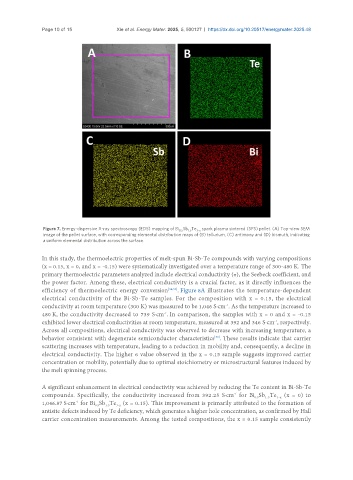
                Figure 7. Energy-dispersive X-ray spectroscopy (EDS) mapping of Bi Sb Te  spark plasma sintered (SPS) pellet. (A) Top-view SEM
                                                             0.5  1.5  3-x
                image of the pellet surface, with corresponding elemental distribution maps of (B) tellurium, (C) antimony and (D) bismuth, indicating
                a uniform elemental distribution across the surface.

               In this study, the thermoelectric properties of melt-spun Bi-Sb-Te compounds with varying compositions
               (x = 0.15, x = 0, and x = -0.15) were systematically investigated over a temperature range of 300-480 K. The
               primary thermoelectric parameters analyzed include electrical conductivity (σ), the Seebeck coefficient, and
               the power factor. Among these, electrical conductivity is a crucial factor, as it directly influences the
               efficiency of thermoelectric energy conversion [34,35] . Figure 8A illustrates the temperature-dependent
               electrical conductivity of the Bi-Sb-Te samples. For the composition with x = 0.15, the electrical
               conductivity at room temperature (300 K) was measured to be 1,046 S·cm . As the temperature increased to
                                                                             -1
               480 K, the conductivity decreased to 739 S·cm . In comparison, the samples with x = 0 and x = -0.15
                                                        -1
                                                                                              -1
               exhibited lower electrical conductivities at room temperature, measured at 392 and 346 S·cm , respectively.
               Across all compositions, electrical conductivity was observed to decrease with increasing temperature, a
               behavior consistent with degenerate semiconductor characteristics . These results indicate that carrier
                                                                         [36]
               scattering increases with temperature, leading to a reduction in mobility and, consequently, a decline in
               electrical conductivity. The higher σ value observed in the x = 0.15 sample suggests improved carrier
               concentration or mobility, potentially due to optimal stoichiometry or microstructural features induced by
               the melt spinning process.


               A significant enhancement in electrical conductivity was achieved by reducing the Te content in Bi-Sb-Te
               compounds. Specifically, the conductivity increased from 392.25 S·cm  for Bi Sb Te  (x = 0) to
                                                                                -1
                                                                                          1.5
                                                                                              3-x
                                                                                       0.5
                           -1
               1,046.87 S·cm  for Bi Sb Te  (x = 0.15). This improvement is primarily attributed to the formation of
                                        3-x
                                     1.5
                                 0.5
               antisite defects induced by Te deficiency, which generates a higher hole concentration, as confirmed by Hall
               carrier concentration measurements. Among the tested compositions, the x = 0.15 sample consistently

