


Page 209 - Read Online
P. 209
Page 8 of 15             Xie et al. Energy Mater. 2025, 5, 500127  https://dx.doi.org/10.20517/energymater.2025.48


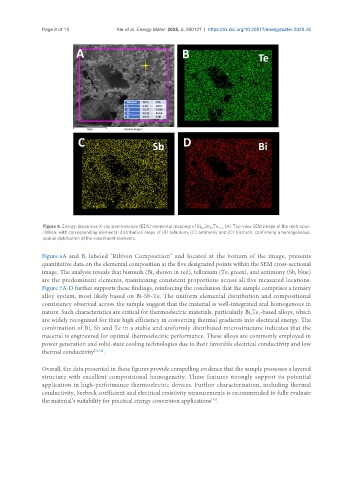
                Figure 4. Energy-dispersive X-ray spectroscopy (EDS) elemental mapping of Bi Sb Te . (A) Top-view SEM image of the melt-spun
                                                                           3-x
                                                                     0.5
                                                                        1.5
                ribbon, with corresponding elemental distribution maps of (B) tellurium, (C) antimony and (D) bismuth, confirming a homogeneous
                spatial distribution of the constituent elements.
               Figure 6A and B, labeled "Ribbon Composition" and located at the bottom of the image, presents
               quantitative data on the elemental composition at the five designated points within the SEM cross-sectional
               image. The analysis reveals that bismuth (Bi, shown in red), tellurium (Te, green), and antimony (Sb, blue)
               are the predominant elements, maintaining consistent proportions across all five measured locations.
               Figure 7A-D further supports these findings, reinforcing the conclusion that the sample comprises a ternary
               alloy system, most likely based on Bi-Sb-Te. The uniform elemental distribution and compositional
               consistency observed across the sample suggest that the material is well-integrated and homogenous in
               nature. Such characteristics are critical for thermoelectric materials, particularly Bi Te -based alloys, which
                                                                                        3
                                                                                     2
               are widely recognized for their high efficiency in converting thermal gradients into electrical energy. The
               combination of Bi, Sb and Te in a stable and uniformly distributed microstructure indicates that the
               material is engineered for optimal thermoelectric performance. These alloys are commonly employed in
               power generation and solid-state cooling technologies due to their favorable electrical conductivity and low
               thermal conductivity [31,32] .


               Overall, the data presented in these figures provide compelling evidence that the sample possesses a layered
               structure with excellent compositional homogeneity. These features strongly support its potential
               application in high-performance thermoelectric devices. Further characterization, including thermal
               conductivity, Seebeck coefficient and electrical resistivity measurements is recommended to fully evaluate
               the material’s suitability for practical energy conversion applications .
                                                                        [33]

